The Rise of AI Data Centers: Building the Foundations of the Middle East’s Digital Future
The Dawn of AI-Driven Digital Transformation in the Middle East
The Middle East is no longer a passive consumer of cloud and AI services. It is fast evolving into a global powerhouse for artificial intelligence (AI) and digital infrastructure, with AI data centers playing a pivotal role in this transformation. Fueled by visionary government initiatives, burgeoning smart city projects, and unprecedented investments in cloud and AI computing, the region is setting the base for a next-generation digital economy. Saudi Arabia and the UAE are at the forefront, spearheading ambitious initiatives to develop large-scale data center campuses, dedicated cloud regions, and specialized AI training facilities.
Unprecedented Capacity Expansion and Market Growth
The AI data center market in the Middle East is surging at a remarkable pace, underpinned by massive infrastructure investments. As of early 2025, Saudi Arabia already boasts around 300 megawatts (MW) of data center capacity, marginally ahead of the UAE’s approximately 250 MW. However, the forecast for 2025-2030 signals explosive growth, with Saudi Arabia on track to add 1,300 MW of new data center capacity, far outpacing the UAE’s planned 500 MW by 2030.
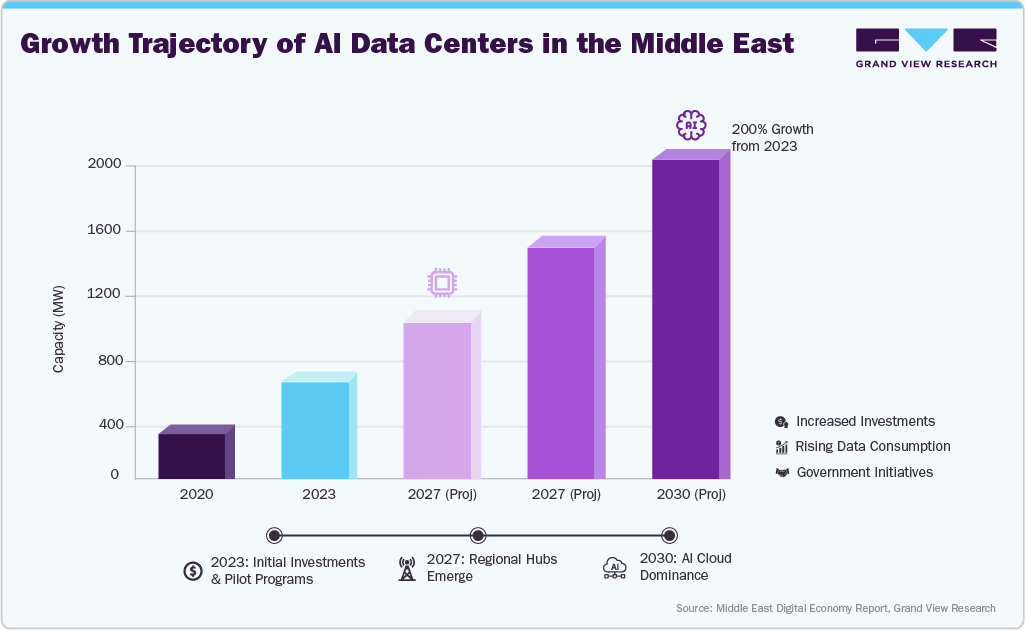
This expansion includes hyperscale facilities purpose-built to handle complex AI workloads and cloud services, positioning the Kingdom as the region’s AI infrastructure leader. Overall, the Middle East AI data center market is expected to grow at a compound annual growth rate (CAGR) of roughly 28% through 2030, reflecting soaring demand and technological ambition. On a strategic level, investments in AI data centers are attracting top global cloud providers and technology innovators, creating a vibrant ecosystem of innovation hubs, smart city projects, and AI startups in the region. As the region matures, these data centers will underpin breakthroughs in healthcare diagnostics, energy management, autonomous transportation, and financial technologies.
Enablers of Growth: Policy, Energy & Capital, and Strategic Location
The Middle East’s AI data center surge is powered by three main factors: government initiatives, availability of affordable energy and abundant capital, and its geographic location. On the policy front, national cloud-first mandates, data sovereignty laws, and AI strategies form an enabling environment that accelerates demand for hyperscale AI data centers. Governments are fast-tracking permits and incentivizing private investments, recognizing the critical role of AI infrastructure in economic diversification and competitiveness.
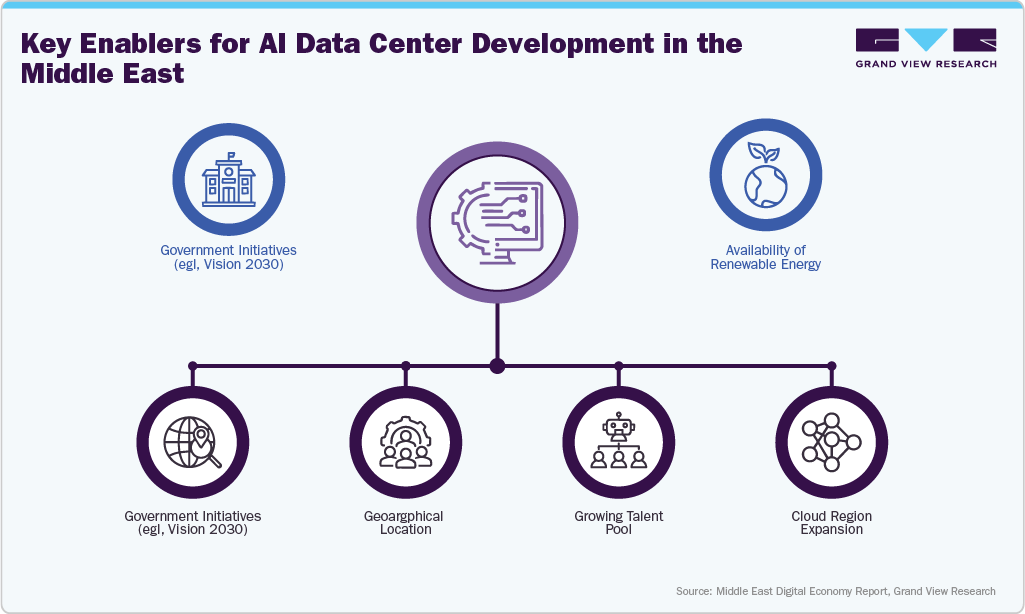
Sovereign wealth funds worth more than $5 trillion give Middle Eastern nations the financial strength to invest in cutting-edge digital infrastructure. Visionary plans like Saudi Vision 2030 and the UAE's National Strategy for the Digital Economy are channeling unprecedented capital into technology and away from oil dependency. With plenty of energy resources, both conventional and renewable, the region can power the massive electricity needs of AI data centers while staying aligned with global sustainability goals. Countries like the UAE and Saudi Arabia are leading the way by using large solar farms and adopting eco-friendly cooling systems to lower their carbon emissions. Finally, the geostrategic location of the region provides a physical meeting point for a vast network of subsea fiber-optic cables connecting Europe, Asia, and Africa, offering low-latency pathways crucial for the digital economy.
Major Projects Redefining AI Infrastructure
|
Country |
Projects |
Developments |
|
UAE |
UAE’s AI Campus in Abu Dhabi |
|
|
KSA |
Oxagon at NEOM – Net-zero AI data-center campus |
|
|
Qatar |
AI and Cloud Expansion |
|
Conclusion: Pioneering the Next Frontier of Digital Transformation
The Middle East’s shift from basic cloud services to AI-ready data centers isn’t just about adding more servers and chips; it’s a move toward building its own independent and advanced technology ecosystem. The region’s rise as a global AI data center hub is one of the most compelling tech stories of the decade. With visionary leadership, unparalleled capital, abundant energy resources, and a drive for technological leadership, the region is building the digital backbone needed for a thriving AI-driven economy. Hyperscale data centers and specialized AI infrastructure are at the heart of this transformation, enabling the Middle East not only to harness AI but also to foster innovation and export AI capabilities globally. The coming years will witness an acceleration of this AI infrastructure revolution, positioning the Middle East as a key player in shaping the future of artificial intelligence worldwide.