- Home
- »
- Next Generation Technologies
- »
-
3D Printing Market Size And Share, Industry Report, 2030GVR Report cover
![3D Printing Market Size, Share & Trends Report]()
3D Printing Market (2024 - 2030) Size, Share & Trends Analysis Report By Component (Hardware, Software, Services), By Printer Type, By Technology, By Software, By Application, By Vertical, By Region, And Segment Forecasts
- Report ID: 978-1-68038-000-2
- Number of Report Pages: 250
- Format: PDF
- Historical Range: 2017 - 2022
- Forecast Period: 2024 - 2030
- Industry: Technology
- Report Summary
- Table of Contents
- Segmentation
- Methodology
- Download FREE Sample
-
 Download Sample Report
3D Printing Market Summary
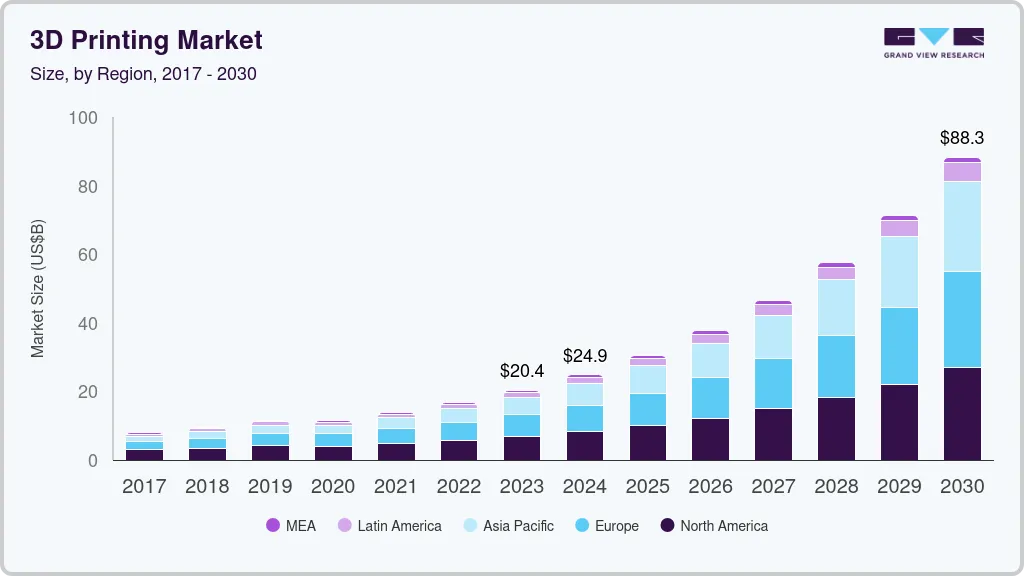
The global 3D printing market size was valued at USD 20.37 billion in 2023 and is projected to reach USD 88.2 billion by 2030, growing at a CAGR of 23.5% from 2024 to 2030. The aggressive research & development in three-dimensional printing and the growing demand for prototyping applications from various industry verticals, particularly healthcare, automotive, and aerospace & defense, are expected to drive the growth of the market.
Key Market Trends & Insights
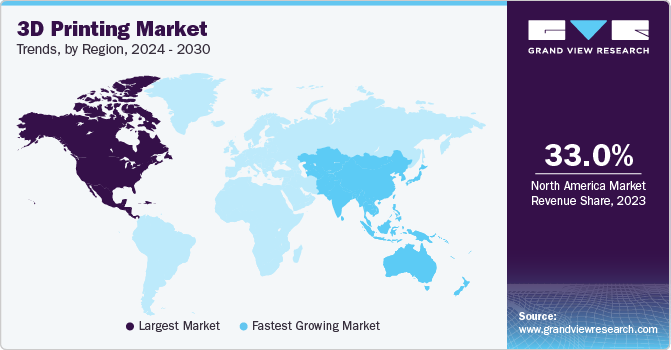
- North America led the market and accounted for more than 33% share of the global revenue in 2023.
- The growth of the 3D printing market in the U.S. is propelled by the technology's ability to facilitate rapid prototyping and product development.
- By printer type, the industrial printer segment led the market and accounted for more than 76.0% share of the global revenue in 2023
- By technology, the stereolithography segment led the market and accounted for more than a 10.0% share of the global revenue in 2023.
- By software, the design software segment led the market and accounted for more than 36% share of the global revenue in 2023.
Market Size & Forecast
- 2023 Market Size: USD 20.37 Billion
- 2030 Projected Market Size: USD 88.2 Billion
- CAGR (2024-2030): 23.5%
- North America: Largest market in 2023
- Asia Pacific: Fastest growing market
The use of 3D printing in industrial applications is usually referred to as additive manufacturing (AM). Additive manufacturing involves a layer-by-layer addition of material to form an object, referring to a three-dimensional file, with the help of software and a 3-dimensional printer. A relevant 3D printing technology is selected from the available set of technologies to implement the process. The last step involves the deployment of this process across different industry verticals based on the necessity.
The deployment includes providing installation services, offering consultation solutions, and customer support, as well as handling aspects related to copyrights, licensing, and patenting. 3D printing is benefiting manufacturers in terms of prototyping, designing of the structure and end products, modeling, and time to market. As a result, the production expenses have been reduced considerably, and the manufacturers are in a position to offer better products at reasonable prices. As a result of these benefits, the demand for 3D printers is expected to be triggered more in the coming years.
However, the prevailing misconceptions with respect to the prototyping processes held by small and medium-scale manufacturers are hindering the adoption of additive manufacturing. Companies involved in designing, particularly small-scale and medium-scale enterprises, are deliberating before considering investments in prototyping as accountable investments rather than trying to understand the advantages and benefits of prototyping. The general notion prevailing among these enterprises is that prototyping is merely an expensive phase prior to manufacturing. Such perceptions regarding prototyping, coupled with the lack of technical knowledge and a looming lack of standard process controls, are expected to hinder market growth.
Market Concentration & Characteristics
The 3D Printing Market growth stage is high. The 3D printing market has witnessed a significant degree of innovation, marked by continuous advancements in 3D printing materials market, printing technologies, and the expansion of applications across diverse industries. Ongoing research and development efforts have led to the introduction of more sophisticated and efficient 3D printers, enabling the production of complex and functional objects with improved speed and precision. The dynamic landscape reflects a continuous quest for innovation, with 3D printing increasingly positioned as a transformative technology driving advancements in manufacturing and design processes.
The target market is also characterized by a high level of mergers & acquisitions by the leading players. The high level of mergers and acquisitions (M&A) in the 3D Printing (3DP) market is driven by the pursuit of market consolidation and strategic expansion. Companies engage in these transactions to access complementary technologies, broaden their product portfolios, and achieve economies of scale. The dynamic nature of the industry, coupled with the need for innovation and global competitiveness, motivates businesses to pursue mergers and acquisitions as a strategic approach to enhance their position in the evolving 3D printing market.
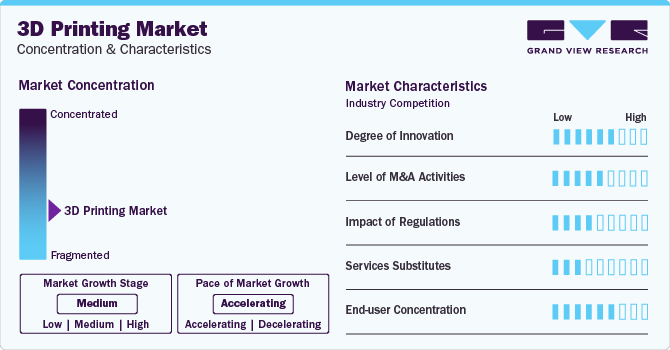
The 3D printing market faces regulatory scrutiny, with authorities focusing on ensuring the safety and quality of printed products, especially in industries like healthcare, where medical devices are produced. Impactful regulations play a role in shaping industry standards and influencing the adoption of 3D printing technologies, particularly in fields where stringent quality control is paramount. As 3D printing continues to advance, ongoing regulatory developments and adherence to standards become crucial factors in determining the market's trajectory and acceptance across various sectors.
Substitutes for 3D printing in the manufacturing sector include traditional manufacturing methods like injection molding and CNC machining, offering alternatives for certain production needs. Additionally, rapid prototyping services using alternative technologies such as stereolithography or selective laser sintering may serve as substitutes in specific applications. Emerging additive manufacturing technologies and advancements in traditional manufacturing methods also contribute to the evolving landscape of alternatives for the 3D printing market.
End user concentration is one of the significant factors in the 3D Printing Market. The end-user industry concentration in the 3D printing market exhibits diversification, with significant adoption observed in sectors such as healthcare, aerospace, and automotive. Healthcare applications include the production of customized medical implants, while aerospace leverages 3D printing for lightweight and complex components. In the automotive sector, 3D printing is increasingly utilized for prototyping, production tooling, and the creation of lightweight structures, showcasing a broad spectrum of applications across various industries.
Printer Type Insights
The industrial printer segment led the market and accounted for more than 76.0% share of the global revenue in 2023. Based on the printer type, the industry has been further segmented into industrial and desktop 3D printers. The large share of industrial 3D printers can be attributed to the extensive adoption of industrial printers in heavy industries, such as automotive, electronics, aerospace and defense, and healthcare. Prototyping, designing, and tooling are some of the most common industrial applications across these industry verticals.
Extensive adoption of 3D printing for prototyping, designing, and tooling is contributing to the growing demand from the industrial sector. Hence, the industrial printers segment is expected to continue dominating during the forecast period. The adoption of desktop 3-dimensional printers was initially limited to hobbyists and small enterprises. However, they are being increasingly used for household and domestic purposes nowadays. The education sector, which comprises schools, educational institutes, and universities, is also deploying desktop printers for technical training and research purposes.
Small businesses are particularly adopting desktop printers and diversifying their business operations to offer 3D printing and other related services. For instance, the concept of ‘fabshops’ is gaining popularity in the U.S. These fabshops offer on-demand 3D printing of parts and components as per the designs and requirements provided by the customers. Hence, the demand for desktop printers is expected to rise significantly during the forecast period.
Technology Insights
The stereolithography segment led the market and accounted for more than a 10.0% share of the global revenue in 2023. Based on technology, segmentation has been divided into stereolithography, fuse deposition modeling (FDM), direct metal laser sintering (DMLS), selective laser sintering (SLS), inkjet, polyjet, laser metal deposition, electron beam melting (EBM), digital light processing, laminated object manufacturing, and others.
Stereolithography technology is one of the oldest and most conventional printing technologies. Although the advantages and ease of operations associated with stereolithography technology are encouraging the adoption of this technology, advances in technology and aggressive research and development activities undertaken by industry experts and researchers are opening opportunities for several other efficient and reliable technologies.
Fused Deposition Modeling (FDM) accounted for a considerable revenue share in 2023 owing to the extensive adoption of the technology across various 3DP processes. The DLP, EBM, inkjet printing, and DMLS segments are expected to witness a growing adoption during the forecast period as these technologies are applicable in specialized additive manufacturing processes. The growing demand from aerospace and defense, healthcare, and automotive verticals would open opportunities for the adoption of these technologies.
Software Insight
The design software segment led the market and accounted for more than 36% share of the global revenue in 2023. It is expected to continue dominating the market during the forecast period. Based on software, the 3DP industry has been segmented into design software, inspection software, printer software, and scanning software. Design software is used for constructing the designs of the object to be printed, particularly in automotive, aerospace and defense, and construction and engineering verticals. Design software acts as a bridge between the objects to be printed and the printer’s hardware.
The demand for scanning software is estimated to grow on account of the growing trend of scanning objects and storing scanned documents. This ability to store the scanned images of the objects irrespective of their size or dimensions for 3-dimensional printing of these objects whenever necessary is expected to drive the scanning software segment during the forecast period. The scanning software segment is expected to register the highest CAGR of 23.8% from 2024 to 2030 and generate considerable revenues during the forecast period in line with the growing adoption of scanners.
Application Insight
The prototyping segment led the market and accounted for more than 54% share of the global revenue in 2023. Based on application, the industry has been segmented further into prototyping, tooling, and functional parts. Prototyping segment accounted for the largest share in 2023 owing to an extensive adoption of the prototyping process across several industry verticals. The automotive, aerospace and defense verticals mainly use prototyping to design and develop parts, components, and complex systems precisely.
Prototyping allows manufacturers to achieve higher accuracy and develop reliable end products. Hence, the prototyping segment is expected to continue dominating the market during the forecast period. Functional parts include smaller joints and other metallic hardware connecting components. The accuracy and precise sizing of these functional parts are of paramount importance while developing machinery and systems. The functional parts segment is expected to expand at a significant CAGR of 24.4% from 2024 to 2030 in line with the increasing demand for designing and building functional parts.
Vertical Insight
The automotive segment led the market and accounted for more than 23% share of the global revenue in 2023. Based on vertical, the industry has been segmented into separate verticals for desktop and industrial 3D printing. The verticals considered for desktop 3DP comprise educational purposes, fashion, jewelry, objects, dental, food, and others. The verticals considered for industrial 3DP comprise automotive, aerospace and defense, healthcare, consumer electronics, industrial, power and energy, and others.
The aerospace and defense, healthcare, and automotive verticals are anticipated to contribute significantly to the growth of industrial additive manufacturing during the forecast period owing to the active adoption of technology in various production processes associated with these verticals. In the healthcare sector, AM helps in the development of artificial tissues and muscles, which replicate the natural human tissues and can be used in replacement surgeries. These capabilities are expected to help in driving the adoption of 3DP across the healthcare vertical and contribute significantly to the growth of the industrial segment.
The dental, fashion and jewelry, and food verticals are anticipated to contribute significantly to the growth of the desktop 3DP segment during the forecast period. The dental vertical dominated the market in 2023 and it is expected to continue dominating the market during the forecast period. The adoption of 3D printing in manufacturing imitation jewelry, miniatures, art and craft, and clothing and apparel is also gaining traction.
Material Insight
The metal segment led the market for 3D printing and accounted for more than 54% share of the global revenue in 2023. Moreover, the metal segment is anticipated to maintain its lead during the forecast period and is expected to expand at the highest CAGR during the forecast period. Based on material, the industry has been segmented further into polymer, metal, and ceramic.
The polymer segment accounted for the second-largest revenue share in 2023. However, the metal segment is anticipated to keep dominating over the forecast period. The metal segment is also expected to grow at a highest CAGR of above 28% from 2024 - 2030. Considering that additive manufacturing using ceramic material is fairly new, the increasing R&D for 3DP technologies such as FDM and inkjet printing has led to rising demand for ceramic AM. The segment is expected to grow at a high CAGR of more than 25% over the forecast period.
Component Insight
The hardware segment led the market and accounted for more than 63% share of the global revenue in 2023. The hardware segment has benefitted significantly from the growing necessity of rapid prototyping and advanced manufacturing practices. The growth of the hardware segment is primarily attributed to various factors such as rapid industrialization, increasing penetration of consumer electronic products, developing civil infrastructure, rapid urbanization, and optimized labor costs.
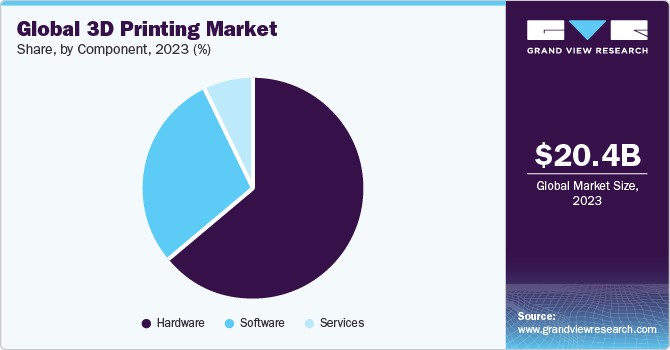
Based on components, the industry has been segmented further into hardware, software, and services. The 3DP hardware component segment has been bifurcated by printer type, technology, applications, vertical, and material. The software segment is further categorized by printer type and software type. The services segment is segregated only by the printer type. The software component segment is expected to witness significant growth during the forecast period.
Regional Insight
North America led the market and accounted for more than 33% share of the global revenue in 2023. This can be attributed to the extensive adoption of additive manufacturing in the region. North American countries, such as the U.S. and Canada, have been among the prominent and early adopters of these technologies in various manufacturing processes. Europe happens to be the largest region in terms of its geographical footprint. It is home to several additive manufacturing industry players with strong technical expertise in additive manufacturing processes. Hence, the European market emerged as the second-largest regional market in 2023.
U.S. 3D Printing Market
The growth of the 3D printing market in the U.S. is propelled by the technology's ability to facilitate rapid prototyping and product development is driving adoption across various industries, including aerospace, automotive, healthcare, and consumer goods.
Asia Pacific 3D Printing Market
The Asia Pacific region is projected to expand at the highest CAGR during 2024 - 2030. This rapid adoption of AM in the Asia Pacific can be attributed to the developments and upgrades across the manufacturing industry within the region. The Asia Pacific region is also emerging as a manufacturing hub for the automotive and healthcare industries. A stronghold on the production of consumer electronics, coupled with rapid urbanization, is also contributing to the region's rising demand for three-dimensional printing.
China 3D Printing Market
The growth of the 3D printing market in China is propelled by government initiatives promoting advanced manufacturing, substantial investments in research and development, and a burgeoning demand for customized products across various industries.
Australia 3D Printing Market
The growth of the 3D printing market in Australia is propelled by increasing adoption of 3D printing in sectors such as healthcare, aerospace, and automotive, driven by cost-effectiveness, technological advancements, and government initiatives.
Japan 3D Printing Market
Japan's 3D printing market expansion is driven by a strong focus on innovation, particularly in sectors like automotive and electronics, coupled with significant investments in additive manufacturing technologies by both government and private entities.
Europe 3D Printing Market
The 3D printing market in Europe is growing due to strong manufacturing heritage, government support for innovation, collaboration between research institutions and companies, diverse industry adoption in aerospace, automotive, healthcare, and consumer goods, and increasing awareness of sustainability benefits.
U.K. 3D Printing Market
The 3D printing market in U.K. is fueled by a robust ecosystem of startups and established players, supported by government funding for research and development, a strong focus on fostering innovation, and partnerships between academia and industry.
France 3D Printing Market
France's 3D printing market expansion is driven by initiatives to enhance competitiveness in manufacturing, investments in research and development, a thriving ecosystem of startups and innovation hubs, and increasing adoption across industries like aerospace, automotive, and consumer goods.
Germany 3D Printing Market
The 3D printing market in Germany is growing due to its strong manufacturing industry, emphasis on precision engineering, robust research and development ecosystem, adoption by automotive and aerospace industries, and potential for personalized healthcare solutions.
MEA 3D Printing Market
The 3D printing market in the Middle East and Africa (MEA) region is growing due to a combination of factors. Technological advancements in 3D printing are making the technology more accessible and affordable, driving innovation and economic growth. The region's growing manufacturing sector is adopting 3D printing for its benefits in rapid prototyping, customization, and cost-effective production. Government initiatives, such as funding research and development projects and providing incentives for businesses, are promoting the adoption of 3D printing technologies.
KSA 3D Printing Market
The growth of the 3D printing market in KSA is fueled by government efforts to diversify the economy, investments in advanced manufacturing technologies, and initiatives to localize production through partnerships with global players, particularly in sectors like construction, healthcare, and defense.
Key Companies & Market Share Insights
Some of the key players operating in the market include 3D Systems, Inc. and Materialise among others.
-
3D Systems, Inc. is the U.S.-based technology company. The company is involved in the development of Desktop 3D printing products and services such as 3D printers, materials, software, 3D scanners and virtual surgical simulators and haptic design tools. Additionally, the company serves its customers with 3D solutions to manufacture and design complex and unique parts, produce parts locally to reduce the lead time, and eliminate expensive tooling, among others. The company caters to numerous industries and verticals such as aerospace & defense, automotive, healthcare, educational, durable goods, and entertainment.
-
Materialise is a Belgium-based technology company operating in the additive manufacturing industry. The company is actively involved in the field of Desktop 3D printing to develop a broad range of software solutions, Desktop 3D printing services, and engineering. The company primarily caters to the industries such as healthcare, aerospace, automotive, consumer goods, and art & design.
madeinspace.us and Voxeljet AG are some of the emerging market participants in the target market.
-
madeinspace.us is an American company engaged in the space-based Desktop 3D printing technology. The company specializes in the engineering, designing, and development of the 3D printers and solutions. The company’s 3D printers are majorly used in spatial environments such as microgravity and vacuum conditions.
-
Voxeljet AG is a German technology company indulged in the mechanical and industrial engineering practices. The company is a manufacturer of three-dimensional printing systems. In addition, the company is operative in the on-demand manufacturing services of models & molds for the metal casting purposes worldwide. The company’s 3D printers operate based on the technologies such as powder binding and additive manufacturing to develop parts by utilizing different sets of materials such as particulate materials or proprietary chemical binding agents. Its major product offerings consist Desktop 3D printing a broad range of Desktop 3D printing systems and Desktop 3D printing materials.
Key 3D Printing Companies:
- 3D Systems, Inc.
- 3DCeram
- Arcam AB
- Autodesk, Inc.
- Canon, Inc.
- Dassault Systemes
- EnvisionTec, Inc.
- EOS (Electro Optical Systems) GmbH
- ExOne
- GE Additive
- HP Inc.
- madeinspace.us
- Materialise NV
- Optomec, Inc.
- Organovo Holdings Inc.
- Proto Labs, Inc.
- Shapeways, Inc.
- Stratasys Ltd.
- Tiertime
- Voxeljet AG
Recent Developments
-
In March 2023, 3D Systems, Inc. announced the launch of NextDent Cast and NextDent Base, two new printing materials, and NextDent LCD1, a printing platform. The materials are designed to enhance material properties, and the printing platform is an easy-to-use small-format printer. With these launches, the company aimed to aid its customers in accelerating additive manufacturing adoption.
-
In November 2023, Autodesk Inc. announced the launch of Autodesk AI. This new technology is available in Autodesk products and is designed to provide customers with generative capabilities and intelligent assistance. With the launch of this new technology in Autodesk products, the company aimed to minimize errors by automating repetitive tasks and the needs of its customers.
-
In February 2022, Dassault Systèmes has announced a strategic partnership with Cadence Design Systems, Inc. to provide integrated solutions for the development of high-performance electronic systems to enterprise customers in a variety of vertical markets, such as high tech, industrial equipment, and transportation and mobility, aerospace and defense, and healthcare.
3D Printing Market Report Scope
Report Attribute
Details
Market size value in 2024
USD 24.8 billion
Revenue forecast in 2030
USD 88.2 billion
Growth Rate
CAGR of 23.5% from 2024 to 2030
Actual Data
2017 - 2023
Forecast period
2024 - 2030
Quantitative units
Revenue in USD Million/Billion and CAGR from 2024 to 2030
Report coverage
Revenue forecast, company ranking, competitive landscape, growth factors, and trends
Segments covered
Component, Printer Type, Technology, Software, Application, Vertical, Material, And Region
Regional scope
North America; Europe; Asia Pacific; South America; MEA
Country scope
U.S., Canada, Mexico, UK, Germany, France, Italy, Spain, Japan, China, India, South Korea, Singapore, Australia, Brazil, KSA, UAE, and South Africa
Key companies profiled
Stratsys, Ltd.; Materialise; EnvisionTec, Inc.; 3D Systems, Inc.; GE Additive; Autodesk Inc.; Made In Space; Canon Inc.; Voxeljet AG
Customization scope
Free report customization (equivalent up to 8 analysts working days) with purchase. Addition or alteration to country, regional & segment scope.
Pricing and purchase options
Avail customized purchase options to meet your exact research needs. Explore purchase options
Global 3D Printing Market Report Segmentation
This report forecasts revenue growth at global, regional, and country levels and provides an analysis of the latest industry trends in each of the sub-segments from 2017 to 2030. For this study, Grand View Research has segmented the global 3D Printing Market report based on component, printer type, technology, software, application, vertical, material, and region.
-
3D Printing Component Outlook (Revenue, USD Million, 2017 - 2030)
-
Hardware
-
Software
-
Services
-
-
3D Printing Printer Type Outlook (Revenue, USD Million, 2017 - 2030)
-
Desktop 3D Printer
-
Industrial 3D Printer
-
-
3D Printing Technology Outlook (Revenue, USD Million, 2017 - 2030)
-
Stereolithography
-
Fuse Deposition Modeling
-
Selective Laser Sintering
-
Direct Metal Laser Sintering
-
Polyjet Printing
-
Inkjet printing
-
Electron Beam Melting
-
Laser Metal Deposition
-
Digital Light Processing
-
Laminated Object Manufacturing
-
Others
-
-
3D Printing Software Outlook (Revenue, USD Million, 2017 - 2030)
-
Design Software
-
Inspection Software
-
Printer Software
-
Scanning Software
-
-
3D Printing Application Outlook (Revenue, USD Million, 2017 - 2030)
-
Prototyping
-
Tooling
-
Functional Parts
-
-
3D Printing Vertical Outlook (Revenue, USD Million, 2017 - 2030)
-
Industrial 3D Printing
-
Automotive
-
Aerospace & Defense
-
Healthcare
-
Consumer Electronics
-
Industrial
-
Power & Energy
-
Others
-
-
Desktop 3D Printing
-
Educational Purpose
-
Fashion & Jewelry
-
Objects
-
Dental
-
Food
-
Others
-
-
-
3D Printing Material Outlook (Revenue, USD Million, 2017 - 2030)
-
Polymer
-
Metal
-
Ceramic
-
-
Regional Outlook (Revenue, USD Million, 2017 - 2030)
-
North America
-
U.S.
-
Canada
-
Mexico
-
-
Europe
-
U.K.
-
Germany
-
France
-
Italy
-
Spain
-
-
Asia Pacific
-
China
-
Japan
-
India
-
South Korea
-
Australia
-
Singapore
-
-
South America
-
Brazil
-
-
Middle East and Africa (MEA)
-
KSA
-
UAE
-
South Africa
-
-
Frequently Asked Questions About This Report

Share this report with your colleague or friend.
Need a Tailored Report?
Customize this report to your needs — add regions, segments, or data points, with 20% free customization.


ISO 9001:2015 & 27001:2022 Certified
We are GDPR and CCPA compliant! Your transaction & personal information is safe and secure. For more details, please read our privacy policy.
Trusted market insights - try a free sample
See how our reports are structured and why industry leaders rely on Grand View Research. Get a free sample or ask us to tailor this report to your needs.