- Home
- »
- Petrochemicals
- »
-
Activated Carbon Market Size, Share, Industry Report, 2033GVR Report cover
![Activated Carbon Market Size, Share & Trends Report]()
Activated Carbon Market (2025 - 2033) Size, Share & Trends Analysis Report By Type (Powdered, Granular), By Application (Liquid Phase, Gas Phase), By End Use (Water Treatment, Food & Beverage Processing), By Region, And Segment Forecasts
- Report ID: 978-1-68038-073-6
- Number of Report Pages: 70
- Format: PDF
- Historical Range: 2021 - 2023
- Forecast Period: 2025 - 2033
- Industry: Bulk Chemicals
- Report Summary
- Table of Contents
- Interactive Charts
- Methodology
- Download FREE Sample
-
 Download Sample Report
Activated Carbon Market Summary
The global activated carbon market size was estimated at USD 3,934.1 million in 2024 and is projected to reach USD 5,497.3 million by 2033, growing at a CAGR of 3.8% from 2025 to 2033. The industry is primarily driven by rising environmental regulations and growing concerns surrounding water and air pollution across industrial, municipal, and residential sectors.
Key Market Trends & Insights
- Asia Pacific dominated the activated carbon market with the largest revenue share of 49.0% in 2024.
- The market in China is expected to grow at a significant CAGR of 3.8% from 2025 to 2033.
- By type, the powdered activated carbon segment is expected to grow at a significant CAGR of 4.0% from 2025 to 2033 in terms of revenue.
- By application, the gas phase segment held the largest revenue share of 53.6% in 2024 in terms of value.
- By end use, the water treatment segment held the largest revenue share of 42.5% in 2024 in terms of value.
Market Size & Forecast
- 2024 Market Size: USD 3,934.1 Million
- 2033 Projected Market Size: USD 5,497.3 Million
- CAGR (2025-2033): 3.8%
- Asia Pacific: Largest market in 2024
- Middle East & Africa: Fastest growing market
Stringent norms imposed by regulatory bodies such as the U.S. EPA, EU REACH, and China's Ministry of Ecology and Environment have intensified the demand for activated carbon in water treatment, industrial gas purification, and air filtration applications. The surge in pharmaceutical and food & beverage manufacturing, requiring high-purity processing, is bolstering adoption. The market is poised for significant growth opportunities driven by increasing investments in sustainable infrastructure, wastewater recycling, and emission control technologies.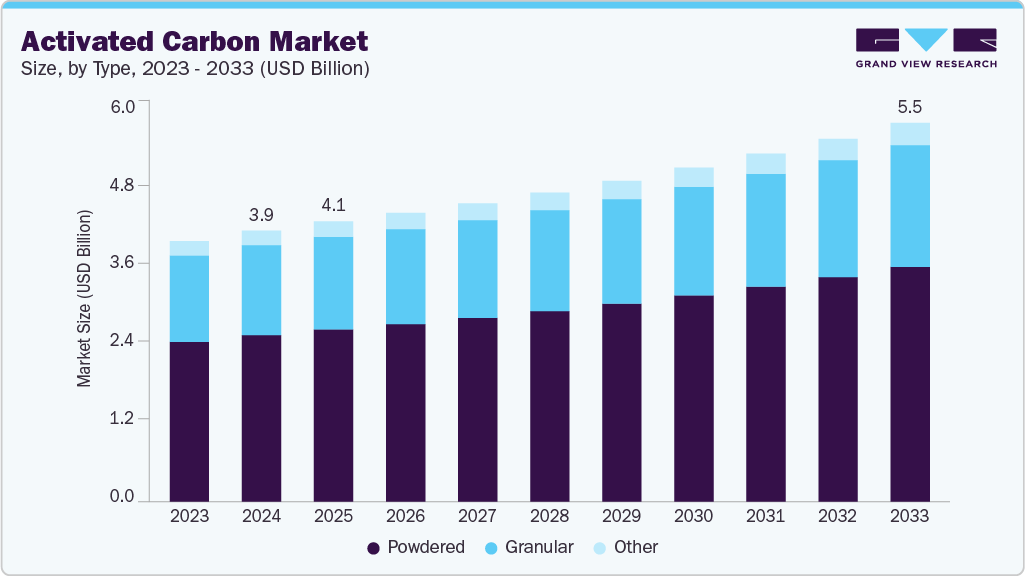
The rising emphasis on circular economy models and zero-liquid discharge systems, particularly in emerging economies across Asia Pacific and Latin America, presents a lucrative avenue for activated carbon suppliers. Additionally, technological advancements in bio-based and renewable activated carbon production offer promising potential to address growing environmental concerns and meet the rising demand for eco-friendly adsorbents.
Despite robust demand, the activated carbon market faces key challenges, including supply chain disruptions and price volatility of raw materials such as coconut shells, coal, and wood. The industry also contends with environmental concerns associated with conventional manufacturing methods, which can be energy-intensive and carbon-emitting. Furthermore, intense competition from alternative filtration technologies such as ion exchange resins and membrane filtration may limit adoption in certain end-use sectors.
Market Concentration & Characteristics
The market is moderately fragmented, with a few global players, such as Boyce Carbon, Cabot Corporation, and Kuraray Co., are some of the prominent companies that dominate the competitive landscape. These companies benefit from their scale of operations, competitive pricing, and diversified product offerings. They are actively investing in research and development, expanding production capacities, and focusing on sustainable practices to strengthen their positions in the competitive market.
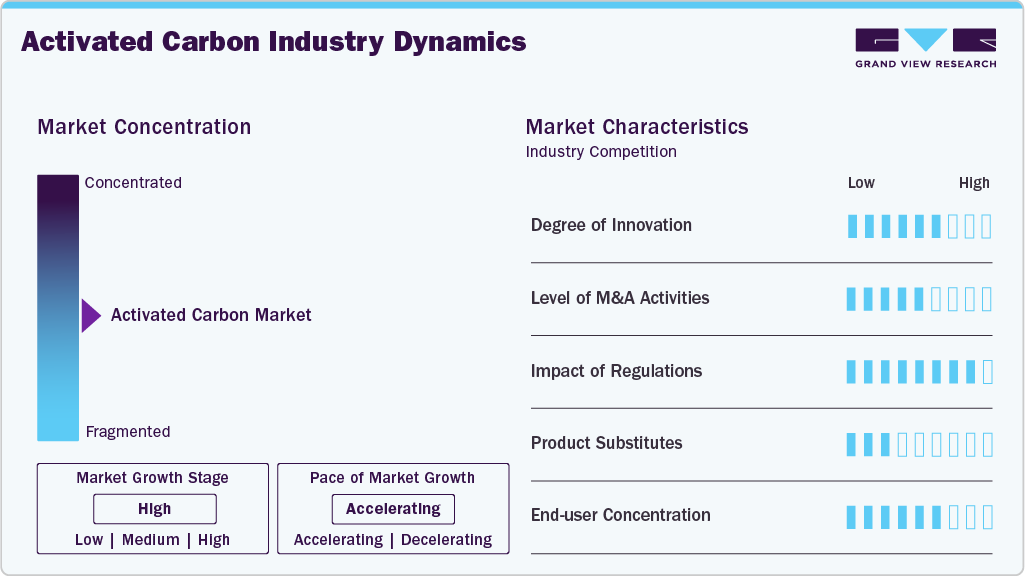
Leading players in the industry are adopting a combination of strategic expansions, mergers & acquisitions, and product innovation to strengthen their market position and enhance global reach. Companies are increasingly investing in capacity expansions and the development of sustainable, bio-based activated carbon products to meet the growing demand for eco-friendly solutions across water and air purification applications. Strategic collaborations with municipal bodies and industrial clients are enabling long-term supply agreements, securing revenue stability.
Type Insights
The powdered activated carbon (PAC) segment held the largest revenue share of 61.4% in 2024, primarily due to its widespread applicability, high adsorption efficiency, and cost-effectiveness across key industries such as municipal water treatment, food & beverage processing, and pharmaceuticals. Its fine particle size offers a significantly larger surface area compared to other forms, enabling faster and more effective removal of contaminants such as organic compounds, chlorine, and micropollutants. This advantage has made PAC the preferred choice for batch treatment processes, emergency spill responses, and seasonal water quality management. The flexibility in dosing and ease of handling have further driven its adoption in both centralized and decentralized treatment systems, especially in regions with limited infrastructure.
The growing demand for clean-label and high-purity products in the food, beverage, and pharmaceutical sectors has bolstered the use of PAC due to its effectiveness in decolorization, deodorization, and purification processes. The segment also benefits from regulatory frameworks mandating higher purity levels in potable water and consumables, particularly in developed regions such as North America and Europe. Ongoing concerns over emerging contaminants such as PFAS and pharmaceutical residues in water bodies have prompted municipalities and industrial facilities to increasingly rely on PAC-based treatment systems. These factors, coupled with its competitive pricing and rapid deployment capabilities, have solidified PAC’s dominant position in the global activated carbon market.
End Use Insights
The water treatment segment held the largest revenue share of 42.5% in 2024, primarily driven by escalating global concerns over access to clean and safe drinking water, alongside increasingly stringent water quality regulations. Activated carbon plays a pivotal role in the removal of organic contaminants, chlorine, pesticides, pharmaceutical residues, PFAS, and heavy metals from water sources, making it indispensable in municipal and industrial water treatment systems. Governments and regulatory bodies across developed and developing nations have introduced stricter discharge and potable water standards, thereby accelerating the deployment of activated carbon technologies in municipal utilities, wastewater treatment facilities, and industrial effluent treatment plants.
The growing adoption of decentralized water treatment solutions in residential, commercial, and rural sectors, particularly in regions facing water scarcity or pollution, has further fueled demand for activated carbon. The material's effectiveness in taste and odor removal has also made it a preferred choice for point-of-use and point-of-entry filtration systems. Moreover, as water reuse and recycling gain momentum under sustainability and resource optimization initiatives, industries such as power, chemicals, and textiles are integrating activated carbon into their zero-liquid discharge (ZLD) and closed-loop systems. These factors, combined with rising public health awareness and investment in water infrastructure, have reinforced the dominance of the water treatment segment in the global activated carbon market.
Application Insights
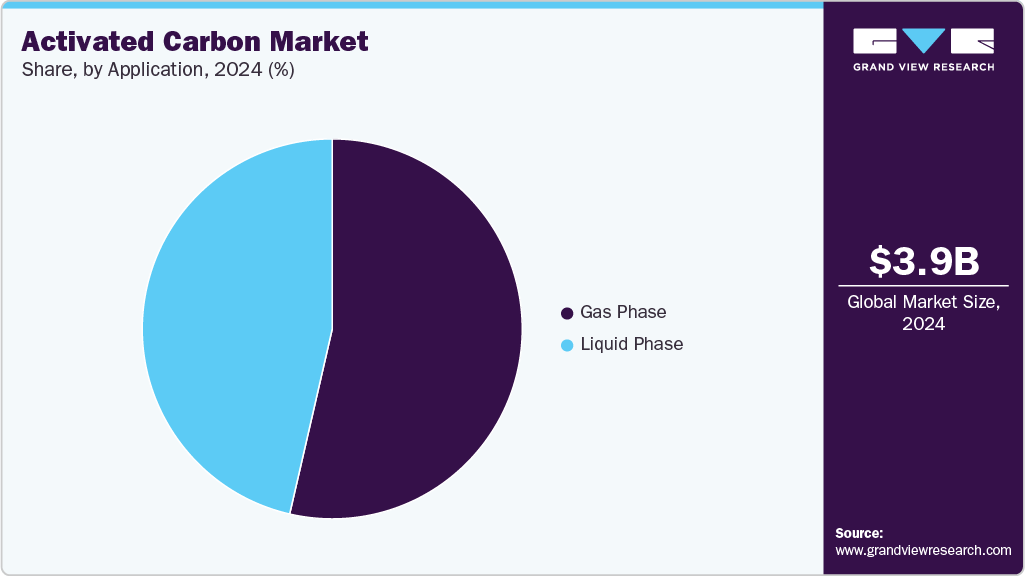
The gas phase segment accounted for the largest revenue share of 53.6% in 2024, driven by the rising global emphasis on air quality management, industrial emission control, and regulatory compliance. Activated carbon’s effectiveness in adsorbing volatile organic compounds (VOCs), sulfur compounds, and other hazardous air pollutants has positioned it as a critical component in flue gas treatment, solvent recovery systems, and automotive emission control technologies. With stringent regulations such as the U.S. Clean Air Act, Euro 6 standards, and China’s Air Pollution Prevention and Control Action Plan coming into force, industries across manufacturing, power generation, and chemicals have been compelled to adopt activated carbon-based gas purification solutions. This shift has significantly contributed to the segment’s revenue dominance.
In addition to industrial uses, the growing adoption of activated carbon in consumer-level air purification systems, HVAC filters, and automotive cabin air filters has further supported demand across residential and commercial sectors. Rising concerns over indoor air pollution, especially in densely populated urban centers, have spurred the deployment of advanced filtration systems that rely on granular and impregnated activated carbon for effective odor, allergen, and toxin removal. The expanding application of gas phase activated carbon in emerging areas such as EV battery off-gas filtration, cleanroom environments, and electronics manufacturing has also created new revenue streams.
Regional Insights
Asia Pacific activated carbon market dominated the global industry with a commanding 49.0% share in 2024, supported by rapid industrialization, rising environmental concerns, and growing investments in water and air purification infrastructure. The region’s leadership is anchored by strong demand from municipal water treatment, pharmaceuticals, food processing, and automotive sectors, particularly in countries like China, India, Japan, and South Korea. Government-led initiatives to curb pollution, improve public health, and expand access to potable water have driven the adoption of activated carbon technologies across both urban and rural areas.
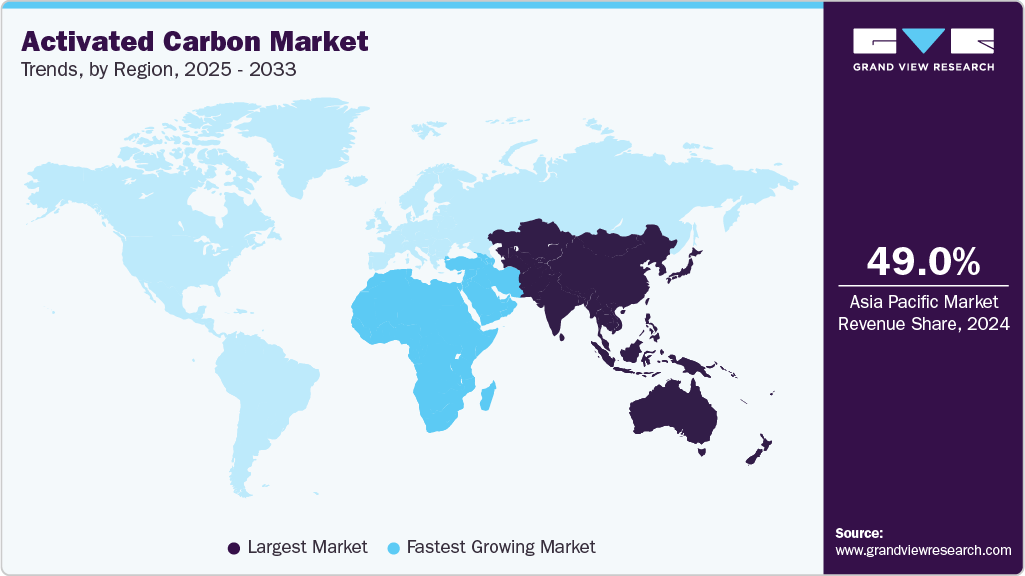
China activated carbon market remained the single largest contributor within Asia Pacific, owing to its extensive industrial base, severe air and water pollution challenges, and aggressive regulatory measures under the government’s environmental protection agenda. The country has implemented stricter emission control norms under the Blue Sky Protection Campaign, boosting the use of activated carbon in gas-phase applications across power plants, manufacturing, and automotive industries. Additionally, large-scale investments in municipal water treatment infrastructure and industrial wastewater reuse have sustained robust demand.
North America Activated Carbon Market Trends
The activated carbon market in North America accounted for 25.7% of the global market in 2024, driven by a strong regulatory framework, advanced water and air treatment infrastructure, and rising demand for high-purity applications. The U.S. Environmental Protection Agency (EPA) regulations targeting contaminants like PFAS, VOCs, and mercury have significantly influenced industrial adoption of activated carbon across water utilities, chemical manufacturing, and energy generation sectors. The market is further bolstered by consumer demand for indoor air purification systems, automotive filtration, and pharmaceutical-grade purification processes.
US Activated Carbon Market Trends
The activated carbon market in the U.S. represented the core of North America’s activated carbon market, backed by rigorous environmental compliance standards, a mature water treatment network, and a strong presence of global manufacturers. High demand stems from regulatory actions such as the PFAS Action Plan and Clean Water Act, which have prompted municipal utilities and industrial players to adopt advanced filtration technologies. The country is also witnessing an increasing uptake of activated carbon in point-of-use water systems, HVAC filtration, and pharmaceutical applications.
Europe Activated Carbon Market Trends
The activated carbon market in Europe held a 16.7% share in 2024, supported by stringent environmental regulations, a well-established food and pharmaceutical industry, and strong momentum toward sustainability and circular economy goals. The European Application Agency (ECHA) and regional water directives have pushed for improved filtration and emission control systems, increasing reliance on high-grade activated carbon in air purification, industrial emissions, and drinking water safety. The region is also witnessing a growing shift toward bio-based and reactivated carbon as part of decarbonization strategies.
Germany activated carbon market stood out as a key market within Europe due to its advanced environmental standards, strong industrial base, and leadership in sustainable technologies. Activated carbon is widely used in flue gas cleaning, air filtration, and water purification, driven by strict compliance with EU emission directives. The country’s emphasis on green manufacturing and renewable energy transition has also spurred adoption in chemical, automotive, and utility sectors.
Latin America Activated Carbon Market Trends
The activated carbon market in Latin America accounted for 4.7% of the global market in 2024, with growth driven by increasing awareness of water quality, urbanization, and regulatory improvements across countries like Brazil, Mexico, and Argentina. While the region’s infrastructure for advanced filtration is still evolving, government initiatives to address water scarcity and pollution have started to create demand for activated carbon in municipal water treatment and industrial effluent management.
Middle East & Africa Activated Carbon Market Trends
The activated carbon market in the Middle East & Africa region held a 4.0% share in 2024, with demand largely driven by desalination, water reuse, and air purification requirements. Countries like Saudi Arabia, UAE, and South Africa are witnessing the growing adoption of activated carbon in municipal and industrial water treatment, especially as part of their sustainability and infrastructure modernization efforts. The harsh climatic conditions and limited freshwater resources are encouraging investments in advanced filtration and zero-liquid discharge systems, where activated carbon plays a critical role.
Key Activated Carbon Companies Insights
Key players operating in the activated carbon market are undertaking various initiatives to strengthen their presence and increase the reach of their products and services. Strategies such as expansion activities and partnerships are key in propelling the market growth.
Key Activated Carbon Companies:
The following are the leading companies in the activated carbon market. These companies collectively hold the largest market share and dictate industry trends.
- CarbPure Technologies
- Boyce Carbon
- Cabot Corporation
- Kuraray Co.
- CarboTech AC GmbH
- Donau Chemie AG,
- Haycarb (Pvt) Ltd.
- Jacobi Carbons Group
- Kureha Corporation
- Osaka Gas Chemical Co.; Ltd.
- Evoqua Water Technologies LLC.
- Carbon Activated Corporation
- Hangzhou Nature Technology Co., Ltd.
- CarbUSA
- Sorbent JSC
Recent Developments
-
In January 2023, Ningbo Juhua Chemical & Science Co., Ltd. awarded a contract to Technip Energies for an Activated Carbon plant with an annual capacity of 72 kilo tons in Ningbo, Zhejiang, China. This is part of the company’s initiative to expand its petrochemical new material business.
-
In January 2024, Germany-based chemical manufacturer Nordmann acquired Italy-based SD Chemicals S.r.l., a distributor of raw materials catering to the cosmetics industry, catering to skin care, hair care, and makeup applications. This acquisition will enable Nordmann to expand its presence and enhance customer reach.
Activated Carbon Market Report Scope
Report Attribute
Details
Market size value in 2025
USD 4,068.8 million
Revenue forecast in 2033
USD 5,497.3 million
Growth rate
CAGR of 3.8% from 2025 to 2033
Base year for estimation
2024
Historical data
2021 - 2023
Forecast period
2025 - 2033
Quantitative units
Volume in kilotons; revenue in USD million/billion, and CAGR from 2025 to 2033
Report coverage
Volume & revenue forecast, company ranking, competitive landscape, growth factors, and trends
Segments covered
Type, application, end use, region
Regional scope
North America; Europe; Asia Pacific; Middle East & Africa; Latin America
Country scope
U.S.; Canada; Mexico; Germany; UK; France; Italy; Spain; China; India; Japan; Australia; South Korea; Saudi Arabia; South Africa; Brazil; Argentina
Key companies profiled
CarbPure Technologies; Boyce Carbon; Cabot Corporation; Kuraray Co.; CarboTech AC GmbH; Donau Chemie AG; Haycarb (Pvt) Ltd.; Jacobi Carbons Group; Kureha Corporation; Osaka Gas Chemical Co., Ltd.; Evoqua Water Technologies LLC.; Carbon Activated Corporation; Hangzhou Nature Technology Co., Ltd.; CarbUSA; Sorbent JSC.
Customization scope
Free report customization (equivalent up to 8 analysts’ working days) with purchase. Addition or alteration to country, regional & segment scope.
Pricing and purchase options
Avail customized purchase options to meet your exact research needs. Explore purchase options
Global Activated Carbon Market Report Segmentation
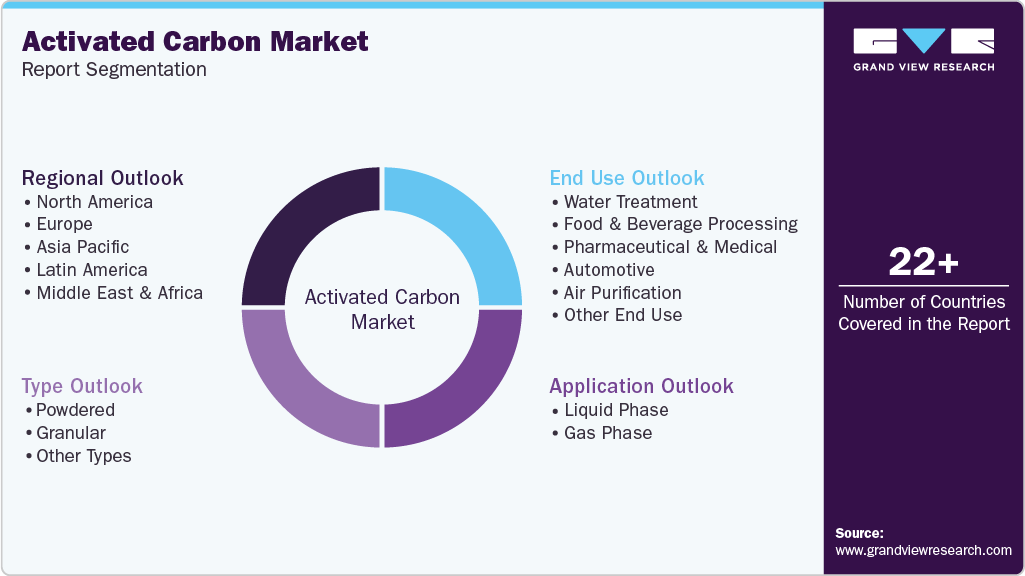
This report forecasts volume & revenue growth at the global, regional, and country levels and provides an analysis of the latest industry trends in each of the sub-segments from 2021 to 2033. For this study, Grand View Research has segmented the global activated carbon market report based on type, application, end use, and region:
-
Type Outlook (Volume, Kilotons; Revenue, USD Million, 2021 - 2033)
-
Powdered
-
Granular
-
Other Types
-
-
Application Outlook (Volume, Kilotons; Revenue, USD Million, 2021 - 2033)
-
Liquid Phase
-
Gas Phase
-
-
End Use Outlook (Volume, Kilotons; Revenue, USD Million, 2021 - 2033)
-
Water Treatment
-
Food & Beverage Processing
-
Pharmaceutical & Medical
-
Automotive
-
Air Purification
-
Other End Use
-
-
Regional Outlook (Volume, Kilotons; Revenue, USD Million, 2021 - 2033)
-
North America
-
U.S.
-
Canada
-
Mexico
-
-
Europe
-
Germany
-
UK
-
France
-
Italy
-
Spain
-
-
Asia Pacific
-
China
-
India
-
Japan
-
Australia
-
South Korea
-
-
Middle East & Africa
-
Saudi Arabia
-
South Africa
-
-
Latin America
-
Brazil
-
Argentina
-
-
Frequently Asked Questions About This Report
b. The global activated carbon market size was estimated at USD 3,934.1 million in 2024 and is expected to reach USD 4,068.8 million in 2025.
b. The global activated carbon market is expected to grow at a compound annual growth rate of 3.8% from 2025 to 2033 to reach USD 5,497.3 million by 2033.
b. The powdered activated carbon (PAC) segment held the largest revenue share in 2024 due to its high adsorption efficiency, cost-effectiveness, and widespread use in water treatment, food processing, and pharmaceutical purification. Its flexibility in dosing and rapid contaminant removal capabilities made it the preferred choice across both municipal and industrial applications.
b. Some of the key players operating in the activated carbon market include CarbPure Technologies, Boyce Carbon, Cabot Corporation, Kuraray Co., CarboTech AC GmbH, Donau Chemie AG, Haycarb (Pvt) Ltd., Jacobi Carbons Group, Kureha Corporation, Osaka Gas Chemical Co.; Ltd., Evoqua Water Technologies LLC., Carbon Activated Corporation, Hangzhou Nature Technology Co., Ltd., CarbUSA, and Sorbent JSC.
b. The market is driven by stringent environmental regulations and the growing need for efficient water and air purification solutions across industrial, municipal, and residential sectors. Rising concerns over contaminant removal, public health, and sustainability are further accelerating adoption globally.


Share this report with your colleague or friend.
Need a Tailored Report?
Customize this report to your needs — add regions, segments, or data points, with 20% free customization.


ISO 9001:2015 & 27001:2022 Certified
We are GDPR and CCPA compliant! Your transaction & personal information is safe and secure. For more details, please read our privacy policy.
Trusted market insights - try a free sample
See how our reports are structured and why industry leaders rely on Grand View Research. Get a free sample or ask us to tailor this report to your needs.