Dihydrocitronellol Market Summary
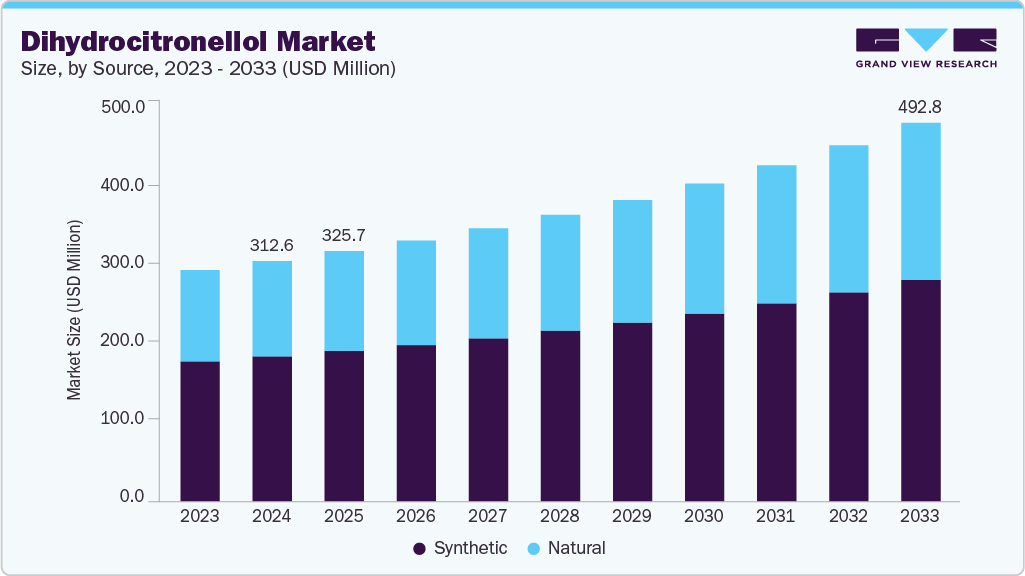
The global dihydrocitronellol market size was estimated at USD 312.6 million in 2024 and is projected to reach USD 492.8 million by 2033, growing at a CAGR of 5.3% from 2025 to 2033. The expanding personal care industry, driven by higher consumer spending on perfumes, skincare, and grooming products, is increasing the need for high-quality fragrance ingredients.
Key Market Trends & Insights
- Asia Pacific is expected to grow at the fastest CAGR of 5.6% from 2025 to 2033, in terms of revenue.
- By source, synthetic segment dominated the market wtih the largest revenue share of 60.3% in 2024.
- By end use, pharmaceuticals segment is expected to grow the fastest CAGR of 5.7% from 2025 to 2033, in terms of revenue.
Market Size & Forecasts
- 2024 Market Size: USD 312.6 Million
- 2033 Projected Market Size: USD 492.8 Million
- CAGR (2025-2033): 5.3%
- Asia Pacific: Largest Market in 2024
Dihydrocitronellol benefits from its soft, long-lasting scent profile, making it a preferred choice in premium and mass-market formulations. As global beauty consumption rises, demand for this aroma compound continues to strengthen. Brands are increasingly reformulating with safer, gentler fragrance materials to meet clean-label and dermatology-friendly expectations. Dihydrocitronellol aligns well with this trend due to its low sensitization potential and stable performance in diverse formulations. This shift supports wider adoption across cosmetics, toiletries, and fine fragrances.
Beyond beauty and personal care, home-care brands are upgrading scent profiles in detergents, fabric conditioners, surface cleaners, and air-care products. Dihydrocitronellol’s strong stability in surfactant-rich and high-pH environments creates an opportunity to supply long-lasting, pleasant fragrances for performance-oriented household products. This opens a high-volume, fast-growing application segment.
Market Concentration & Characteristics
The dihydrocitronellol market is moderately concentrated, with a limited number of global aroma-chemical producers supplying high-purity grades while regional manufacturers cater to lower-value segments. Technical expertise, regulatory compliance, and cost-efficient synthesis create barriers that favor established players but still allow niche entrants offering specialized formulations.
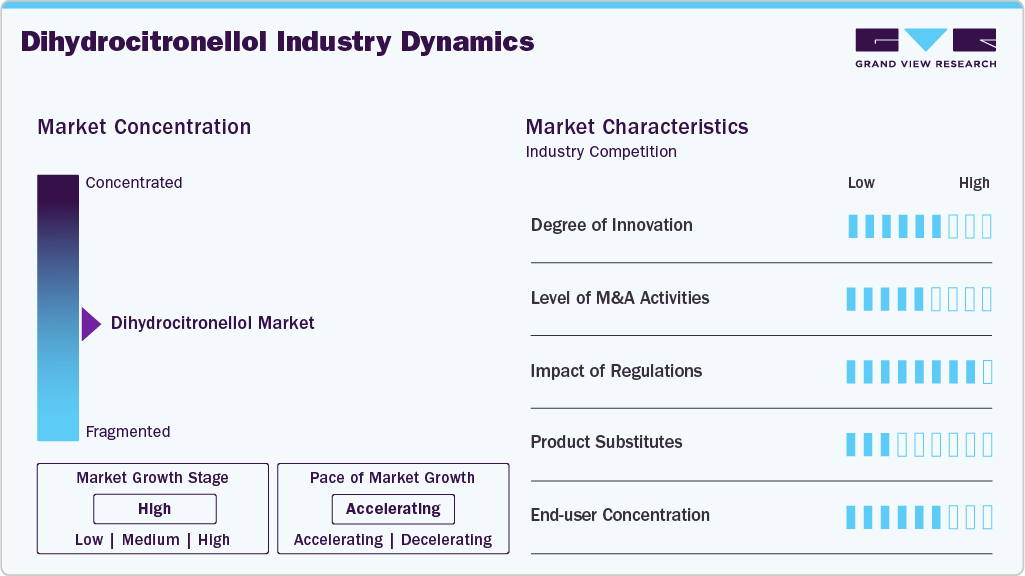
The market is defined by steady demand from fragrances, personal care, and home-care applications, with clear segmentation across technical and cosmetic grades. Pricing is moderately sensitive to feedstock trends, while customers increasingly value consistent quality, safety compliance, and sustainable sourcing. Growth is strongest in Asia, supported by expanding manufacturing and consumer markets.
Source Insights
Synthetic segment dominated with a revenue share of 60.3% in 2024, due to its cost efficiency, consistent quality, and scalability for high-volume applications. Home care, detergents, and mass-market personal-care categories rely on synthetic grades for stable performance and competitive pricing. Its broad availability and formulation reliability keep it the preferred choice for large manufacturers seeking predictable supply and margin control.
Natural segment is growing at the fastest CAGR of 5.8% during the forecast period, as manufacturers shift toward bio-based, clean-label fragrance inputs to align with regulatory and sustainability priorities. Growing preference for plant-derived aroma molecules in premium personal-care formulations is accelerating uptake. Suppliers offering certified and traceable natural grades are gaining competitive advantage in eco-driven markets.
End Use Insights
Personal care and cosmetics segment dominated the market with a revenue share of 36.6% in 2024, due to consistent, high-volume demand for stable and pleasant fragrance molecules across skincare, haircare, and deodorant products. Dihydrocitronellol’s compatibility with diverse formulations and reliable performance reinforces its preferred status among major FMCG players. Established supply networks and stringent quality standards further solidify this segment’s leadership.
Pharmaceutical segment is growing at the fastest CAGR 5.7% over the forecast period. This segment expands rapidly as companies adopt mild, low-sensitization aroma ingredients to enhance patient acceptance in topical and OTC formulations. Dihydrocitronellol’s strong safety and stability profile supports its use in medicated creams and hygiene products. Regulatory preference for gentle excipients further accelerates segment growth.
Regional Insights
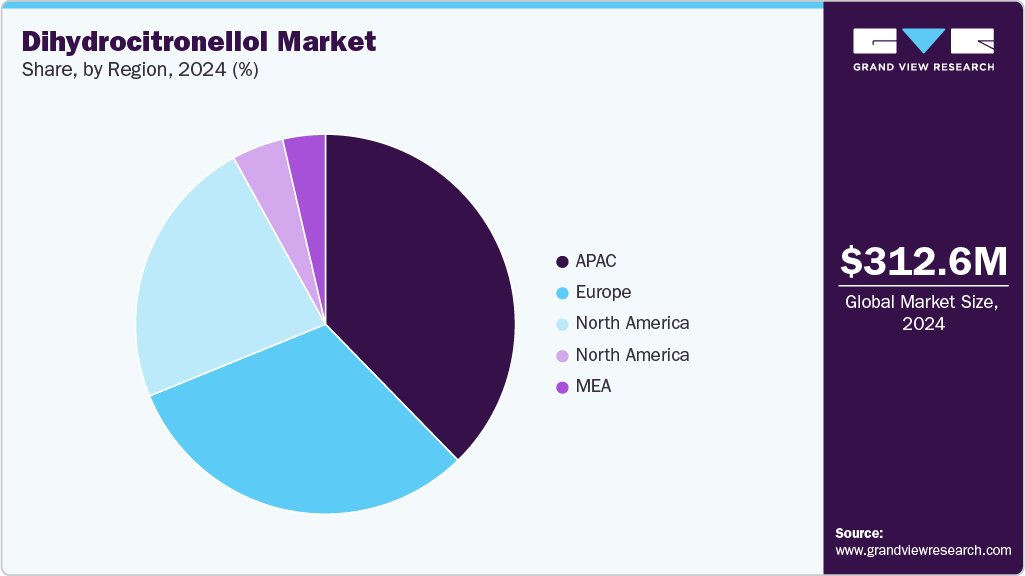
Asia Pacific dominated the market with largest revenue share of 37.7% in 2024. Asia Pacific benefits from large-scale fragrance ingredient manufacturing coupled with rapidly expanding consumer markets for personal and home care products. Rising disposable incomes and mass adoption of scented products significantly boost consumption. The region’s strong production base further enhances market competitiveness.
China Dihydrocitronellol Market Trends
China registered the fastest CAGR of 6.1%, in terms of revenue, during the review period Dihydrocitronellol Market in China is driven by its strong position as a global hub for aroma chemical production supported by cost-efficient manufacturing capabilities. The country’s advanced chemical infrastructure and rising domestic demand enable large-scale usage of fragrance ingredients. This combination reinforces China’s importance in both the consumption and supply of dihydrocitronellol.
Europe Dihydrocitronellol Market Trends
Europe’s market growth is primarily influenced by stringent regulatory standards for fragrance safety and allergen reduction. Manufacturers are shifting toward cleaner, low-sensitizing aroma chemicals, positioning dihydrocitronellol as a preferred option. This alignment with REACH and eco-friendly formulation trends supports steady regional uptake.
Dihydrocitronellol market in Germany is propelled by its advanced specialty chemicals sector and emphasis on high-purity, compliant fragrance materials. Manufacturers prioritize reliability, safety, and performance—qualities aligned with dihydrocitronellol’s properties. The country’s strong formulation expertise supports consistent demand for such high-quality aroma chemicals.
North America Dihydrocitronellol Market Trends
The North American market is driven by strong innovation in premium personal care and home care formulations. Leading brands prioritize high-performance and long-lasting fragrance ingredients, which increases the adoption of dihydrocitronellol. The region’s focus on quality, stability, and consumer experience continues to support sustained demand.
The U.S. dihydrocitronellol market growth is influenced by the strength of its premium beauty and home care categories, where brands emphasize innovation and enhanced sensory appeal. Formulators increasingly seek stable, mild, and long-lasting fragrance ingredients to differentiate product performance. This focus on premiumization continues to support rising demand for dihydrocitronellol.
Latin America Dihydrocitronellol Market Trends
Latin America’s key driver is the growing demand for affordable yet fragrance-rich personal and household care products. Local brands increasingly incorporate stable, pleasant aroma chemicals to differentiate products in a price-sensitive market. This trend supports a consistent rise in the use of dihydrocitronellol across formulations.
Middle East & Africa Dihydrocitronellol Market Trends
The Middle East & Africa is driven by a strong cultural preference for fragranced beauty, hygiene, and home care products. Demand for long-lasting, fresh, and premium scent profiles is expanding across both traditional and modern retail channels. This consumption pattern supports increasing uptake of versatile aroma ingredients like dihydrocitronellol.
Key Dihydrocitronellol Company Insights
Sigma-Aldrich and Takasago lead the market through strong global supply capabilities, high-purity production, and long-standing expertise in aroma chemicals. Their consistent quality and reliable availability make them preferred partners for major fragrance and personal-care manufacturers.
-
Sigma-Aldrich strengthens the dihydrocitronellol market with its wide portfolio of high-purity aroma chemicals and robust global supply network. Its strong industry reputation, reliable product availability, and adherence to strict quality and regulatory standards make it a preferred supplier for fragrance, personal-care, and specialty formulation companies.
-
Takasago plays a significant role in the dihydrocitronellol market with its advanced manufacturing capabilities and deep expertise in fragrance chemistry. The company’s ability to produce high-quality aroma molecules at scale, coupled with its innovation-driven portfolio and strong presence across global consumer markets, reinforces its leadership in supplying dihydrocitronellol for premium formulations.
Key Dihydrocitronellol Companies:
The following are the leading companies in the dihydrocitronellol market. These companies collectively hold the largest market share and dictate industry trends.
- Sigma-Aldrich
- Privi Speciality Chemicals Limited
- Takasago International Corporation
- Aurora Fine Chemicals
- BOC Sciences
- Biosynth
Dihydrocitronellol Market Report Scope
|
Report Attribute
|
Details
|
|
Market size value in 2025
|
USD 325.7 million
|
|
Revenue forecast in 2033
|
USD 492.8 million
|
|
Growth rate
|
CAGR of 5.3% from 2025 to 2033
|
|
Base year for estimation
|
2024
|
|
Historical data
|
2018 - 2023
|
|
Forecast period
|
2025 - 2033
|
|
Quantitative units
|
Volume in kilotons, Revenue in USD million, and CAGR from 2025 to 2033
|
|
Report coverage
|
Revenue forecast, volume forecast, competitive landscape, growth factors, and trends
|
|
Segments covered
|
Source, end use, region
|
|
Regional scope
|
North America; Europe; Asia Pacific; Latin America; Middle East & Africa
|
|
Country scope
|
U.S.; Canada; Mexico; Germany; UK; France; Italy; Spain; China; India; Japan; South Korea; Brazil; Argentina; Saudi Arabia; South Africa
|
|
Key companies profiled
|
Sigma-Aldrich; Privi Speciality Chemicals Limited; Takasago International Corporation; Aurora Fine Chemicals; BOC Sciences; Biosynth
|
|
Customization scope
|
Free report customization (equivalent up to 8 analyst’s working days) with purchase. Addition or alteration to country, regional, and segment scope.
|
|
Pricing and purchase options
|
Avail customized purchase options to meet your exact research needs. Explore purchase options
|
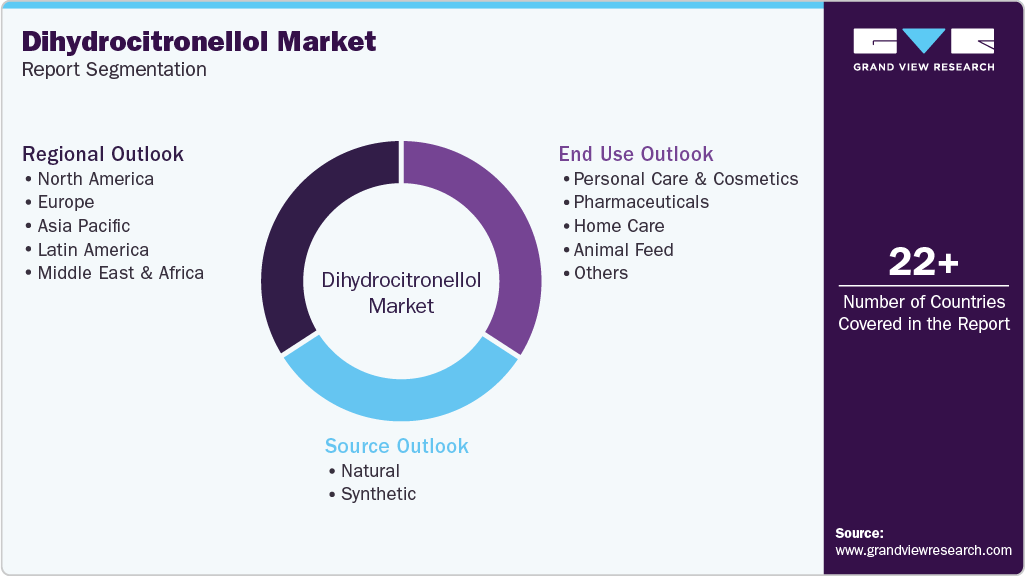
Global Dihydrocitronellol Market Report Segmentation
This report forecasts revenue growth at global, regional, and country levels and provides an analysis of the latest industry trends in each of the sub-segments from 2018 to 2033. For this study, Grand View Research has segmented the global dihydrocitronellol market report based on product, end use, and region:
-
Source Outlook (Revenue, USD Million; Volume, Kilotons, 2018 - 2033)
-
End Use Outlook (Revenue, USD Million; Volume, Kilotons, 2018 - 2033)
-
Regional Outlook (Revenue, USD Million; Volume, Kilotons, 2018 - 2033)
-
North America
-
Europe
-
Germany
-
UK
-
Italy
-
Spain
-
France
-
Asia Pacific
-
China
-
Japan
-
South Korea
-
India
-
Latin America
-
Middle East & Africa
-
Saudi Arabia
-
South Africa
Frequently Asked Questions About This Report
b. The expanding personal care industry, driven by higher consumer spending on perfumes, skincare, and grooming products, is increasing the need for high-quality fragrance ingredients. Dihydrocitronellol benefits from its soft, long-lasting scent profile, making it a preferred choice in premium and mass-market formulations. As global beauty consumption rises, demand for this aroma compound continues to strengthen.
b. The global dihydrocitronellol market size was estimated at USD 312.6 million in 2024 and is expected to reach USD 325.7 million in 2025.
b. The global dihydrocitronellol market is expected to grow at a compound annual growth rate of 5.3% from 2025 to 2033 to reach USD 492.8 million by 2033.
b. Asia Pacific dominated the market with largest revenue share of 37.7% in 2024. Asia Pacific benefits from large-scale fragrance ingredient manufacturing coupled with rapidly expanding consumer markets for personal and home care products.
b. Some key players operating in the dihydrocitronellol market include Sigma-Aldrich, Privi Speciality Chemicals Limited, Takasago International Corporation, Aurora Fine Chemicals, BOC Sciences, Biosynth.

 Download Sample Report