- Home
- »
- Power Generation & Storage
- »
-
Liquid Air Energy Storage Market Size, Industry Report, 2033GVR Report cover
![Liquid Air Energy Storage Market Size, Share & Trends Report]()
Liquid Air Energy Storage Market (2025 - 2033) Size, Share & Trends Analysis Report By Type (Electro-chemical Storage, Pumped Hydro Storage, Thermal Energy Storage), By Application (Utility, Industrial), By Region, And Segment Forecasts
- Report ID: GVR-4-68040-777-0
- Number of Report Pages: 110
- Format: PDF
- Historical Range: 2021 - 2023
- Forecast Period: 2025 - 2033
- Industry: Energy & Power
- Report Summary
- Table of Contents
- Segmentation
- Methodology
- Download FREE Sample
-
 Download Sample Report
Liquid Air Energy Storage Market Summary
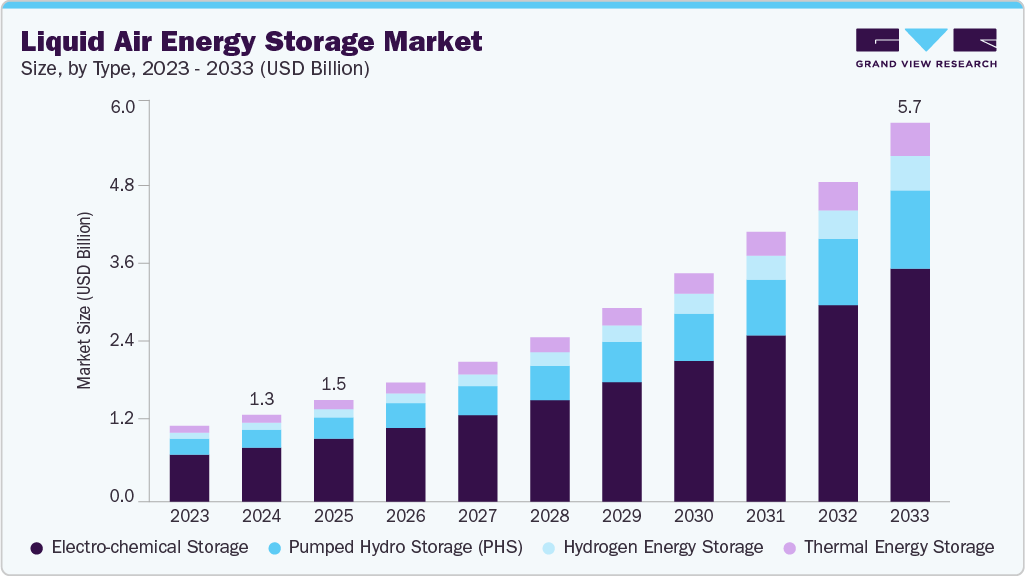
The global liquid air energy storage market size was estimated at USD 1.30 billion in 2024 and is projected to reach USD 5.67 billion by 2033, growing at a CAGR of 17.8% from 2025 to 2033. The rising global demand for large-scale, long-duration energy storage solutions to balance renewable energy generation and grid stability drives the growth of the Liquid Air Energy Storage (LAES) systems.
Key Market Trends & Insights
- Europe liquid air energy storage market held the largest share of 37% of the global market in 2024.
- The liquid air energy storage industry in the U.S. is expected to grow significantly over the forecast period.
- By type, electro-chemical storage held the largest market share of 62% in 2024.
- By application, the utility segment held the largest market share in 2024.
Market Size & Forecast
- 2024 Market Size: USD 1.30 Billion
- 2033 Projected Market Size: USD 5.67 Billion
- CAGR (2025-2033): 17.8%
- Europe: Largest market in 2024
- Asia Pacific: Fastest growing market
Technological advancements in cryogenic storage, combined with declining costs and increasing efficiency, have positioned LAES as a promising alternative to conventional energy storage technologies, particularly in integrating intermittent renewable sources such as wind and solar. Key applications in utility-scale power management, industrial energy storage, and renewable energy backup systems fuel steady adoption. In contrast, strategic collaborations between energy firms and technology providers strengthen market expansion.In North America, market growth is primarily supported by government initiatives promoting grid modernization and large-scale energy storage deployment. Federal and state-level incentives for renewable integration and investments in energy storage research and pilot projects are boosting the adoption of LAES systems. The United States is leveraging abundant renewable resources, such as solar and wind, to deploy LAES as a cost-effective solution for energy balancing and peak shaving. Increasing corporate interest in sustainable energy infrastructure and rising electricity demand are expected to maintain strong market momentum throughout the forecast period.
Europe represents a significant growth hub, with Germany, the United Kingdom, and France leading the adoption due to supportive energy policies and ambitious decarbonization targets. Investments in utility-scale LAES projects, hybrid renewable storage systems, and advanced cryogenic technologies are key drivers of regional demand. The region’s focus on reducing reliance on fossil fuel based peaking power plants and integrating large-scale renewable energy into the grid is expected to accelerate LAES deployment. In addition, ongoing technological collaborations and EU-level funding for energy storage innovation further reinforce Europe’s position as a critical contributor to the global landscape.
Drivers, Opportunities & Restraints
The liquid air energy storage market is primarily driven by the growing need for large-scale, long-duration energy storage solutions to support the integration of renewable energy into power grids. Increasing adoption of intermittent renewable sources such as solar and wind creates demand for reliable storage technologies that balance supply and demand. Government incentives, energy transition policies, and net-zero commitments encourage investments in grid-scale storage projects. Moreover, LAES offers scalability, minimal environmental impact, and the ability to store energy for extended periods, making it increasingly attractive for utilities, industrial users, and commercial power operators.
Opportunities are expanding as technological advancements improve efficiency and reduce costs. Innovations in cryogenic storage systems, air liquefaction processes, and hybrid energy storage configurations enhance energy density and operational reliability. The rising focus on decarbonizing industrial processes, integrating large-scale renewable energy projects, and providing backup power for critical infrastructure creates additional growth avenues. Emerging markets with rapidly growing electricity demand and limited grid stability represent attractive targets for LAES deployment, alongside increasing corporate and utility interest in sustainable energy storage solutions.
However, challenges such as high capital expenditure, complex engineering requirements, and the need for specialized cryogenic infrastructure limit widespread adoption. Energy conversion efficiency, operational losses, and long project development timelines pose additional hurdles. Furthermore, competition from alternative storage technologies such as lithium-ion, flow batteries, pumped hydro storage, regulatory uncertainties, and financing risks for large-scale projects can restrict market growth. Effective integration into existing power networks and establishing commercially viable business models remain critical for the widespread deployment of LAES systems.
Type Insights
The electrochemical storage segment captured the largest revenue share of 62% in 2024, dominating the type segment in the global market. This reflects its widespread adoption for grid-scale energy storage, industrial applications, and renewable integration projects. As one of the most mature and scalable energy storage technologies, electrochemical storage is pivotal in enhancing grid reliability, balancing intermittent renewable energy supply, and supporting decarbonization efforts across power generation and industrial sectors. Its compatibility with hybrid storage systems and ability to provide rapid response times make it a cornerstone of modern energy infrastructure.
Electrochemical storage enables improved energy security, operational flexibility, and cost-effective storage solutions for utilities and large-scale industrial consumers. The segment's growth is reinforced by technological advancements in battery chemistry, declining system costs, and supportive government policies and incentives for energy storage deployment. Increasing corporate and utility commitments to renewable energy integration, expanding storage infrastructure, and strategic investments in hybrid energy systems strengthen market momentum as global energy systems accelerate the transition to low-carbon power. Electrochemical storage's scalability, reliability, and efficiency position as the leading driver of growth in the LAES market.
Application Insights
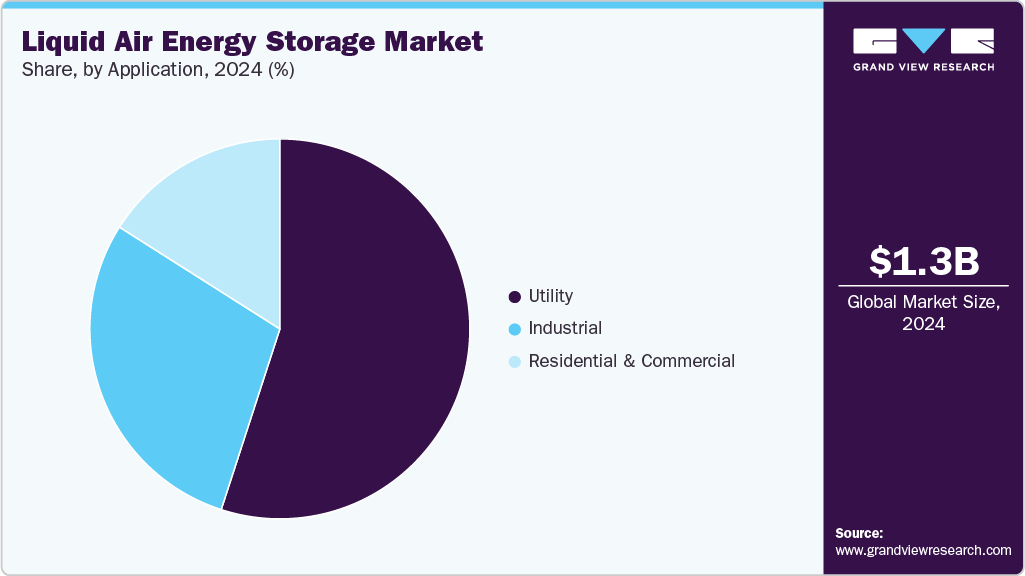
The utility segment registered the largest market share of 55% in 2024 in the liquid air energy storage industry. The dominance of this segment is driven by the growing need for large-scale energy storage solutions to support grid stability, renewable energy integration, and peak demand management. Utilities increasingly rely on LAES systems to store excess renewable energy from solar and wind farms, balance supply-demand fluctuations, and provide ancillary services such as frequency regulation and load shifting. The technology’s ability to deliver long-duration, scalable storage makes it suitable for utility-scale applications.
As energy transition and decarbonization become strategic priorities for power operators, investments in LAES deployment, hybrid energy storage systems, and grid modernization are accelerating. Regulatory support, government incentives, and corporate sustainability initiatives further reinforce the segment’s growth. With rising electricity demand, increasing renewable energy penetration, and the need for reliable backup power, the utility application segment will remain the leading driver of the LAES market globally throughout the forecast period.
Regional Insights
The Europe liquid air energy storage market industry accounted for the largest share of 37% in the global market in 2024. Ambitious decarbonization targets, stringent emission regulations, and strong investments in long-duration energy storage solutions support the region’s leadership. Countries such as Germany, France, the Netherlands, and the UK actively deploy LAES systems to integrate intermittent renewable energy, stabilize power grids, and provide ancillary services. Policy support, including subsidies, research funding, and incentives for energy storage deployment, combined with mature electricity infrastructure, creates a favorable environment for large-scale adoption. Europe’s focus on sustainable energy transition and grid modernization continues to drive market expansion and maintain its leading position globally.

North America Liquid Air Energy Storage Market Trends
The North America liquid air energy storage industry is a key market driven by substantial investments in utility-scale storage projects, supportive federal and state policies, and growing corporate commitments to decarbonization. While the U.S. leads from the front, Canada also contributes through provincial energy storage initiatives and clean energy research programs. Strong public-private collaboration, technological innovation, and grid modernization efforts continue to support North America’s role as a significant LAES region.
The liquid air energy storage industry in the U.S. is driven by significant federal and state-level support, corporate decarbonization commitments, and the growing integration of renewable energy into the power grid. Incentives under the Inflation Reduction Act, renewable energy standards, and funding for long-duration energy storage projects have created a favorable investment environment, enabling the rapid scaling of LAES deployments across utilities and industrial users.
Demand for grid stabilization, peak load management, and renewable energy integration is particularly strong from the utility sector. Industrial applications also contribute to leveraging LAES for reliable backup power, operational flexibility, and energy cost optimization. Investments in research and development, hybrid storage solutions, and infrastructure expansion are further supporting market growth. With abundant renewable energy resources, technological advancements, and supportive policies, the U.S. is expected to remain a leading and dynamic hub for LAES throughout the forecast period.
Asia Pacific Liquid Air Energy Storage Market Trends
The Asia Pacific liquid air energy storage industry is emerging as a high-growth sector, driven by rapid industrialization, urbanization, and strong renewable energy expansion. Countries including China, Japan, India, and South Korea are increasingly investing in large-scale LAES projects to enhance grid stability and integrate growing renewable electricity generation. Government incentives, research programs, and expanding infrastructure for storage deployment are accelerating adoption. Rising electricity demand and the need for energy security further position Asia Pacific as a key contributor to the LAES market growth.
Latin America Liquid Air Energy Storage Market Trends
The liquid air energy storage industry in Latin America is gradually expanding on the back of abundant renewable energy resources, particularly in Brazil and Argentina. Investments in large-scale storage systems and energy transition initiatives help balance variable power generation from solar and wind sources. Government policies, regional energy programs, and international partnerships encourage deployment, positioning the region for steady growth over the forecast period.
Middle East & Africa Liquid Air Energy Storage Market Trends
The Middle East & Africa (MEA) liquid air energy storage industry is seeing gradual growth, driven by energy diversification goals and the adoption of renewable energy. Key economies such as the UAE, Saudi Arabia, South Africa, and Egypt are investing in energy storage to support grid reliability, industrial applications, and renewable integration. Sub-Saharan Africa uses off-grid energy solutions and smaller-scale storage projects to enhance energy access. Policy support, international funding, and public-private collaborations enable regional development, with LAES adoption expected to grow steadily over the forecast period.
Key Liquid Air Energy Storage Company Insights
Some of the key players operating in the global market include General Electric (GE), Linde plc, Messer SE & Co. KGaA, Mitsubishi Hitachi Power Systems, and Siemens Energy, among others. These companies focus on the development and deployment of large-scale LAES systems, investing heavily in research and development, cryogenic energy storage technologies, grid integration solutions, and hybrid storage projects.
Key Liquid Air Energy Storage Companies:
The following are the leading companies in the liquid air energy storage market. These companies collectively hold the largest market share and dictate industry trends.
- Highview Power
- MAN Energy Solutions
- General Electric (GE)
- Linde plc
- Messer SE & Co. KGaA
- Mitsubishi Hitachi Power Systems
- Siemens Energy
- Viridor
- Heatric
- Atlas Copco
Recent Developments
-
In April 2025, Highview Power announced the commissioning of a new commercial-scale Liquid Air Energy Storage facility in the UK. The facility is designed to store up to 250 MWh of energy, providing long-duration, grid-scale storage to balance renewable energy supply and demand. The project is expected to enhance grid stability, support renewable integration, and reduce reliance on fossil fuel-based peaking power plants, contributing to significant reductions in carbon emissions.
Liquid Air Energy Storage Market Report Scope
Report Attribute
Details
Market size value in 2025
USD 1.52 billion
Revenue forecast in 2033
USD 5.67 billion
Growth rate
CAGR of 17.8% from 2025 to 2033
Base year for estimation
2024
Historical data
2021 - 2023
Forecast period
2025 - 2033
Quantitative Units
Revenue in USD million/billion and CAGR from 2025 to 2033
Report coverage
Revenue forecast, competitive landscape, growth factors, and trends
Segments covered
Type, application, region
Regional scope
North America; Europe; Asia Pacific; Latin America; Middle East & Africa
Country scope
U.S.; Canada; Mexico; Germany; UK; France; China; India; Japan; South Korea; Brazil; Saudi Arabia; UAE
Key companies profiled
Highview Power; MAN Energy Solutions; General Electric (GE); Linde plc; Messer SE & Co. KGaA; Mitsubishi Hitachi Power Systems; Siemens Energy; Viridor; Heatric; Atlas Copco
Customization scope
Free report customization (equivalent up to 8 analysts working days) with purchase. Addition or alteration to country, regional & segment scope.
Pricing and purchase options
Avail customized purchase options to meet your exact research needs. Explore purchase options
Global Liquid Air Energy Storage Market Report Segmentation
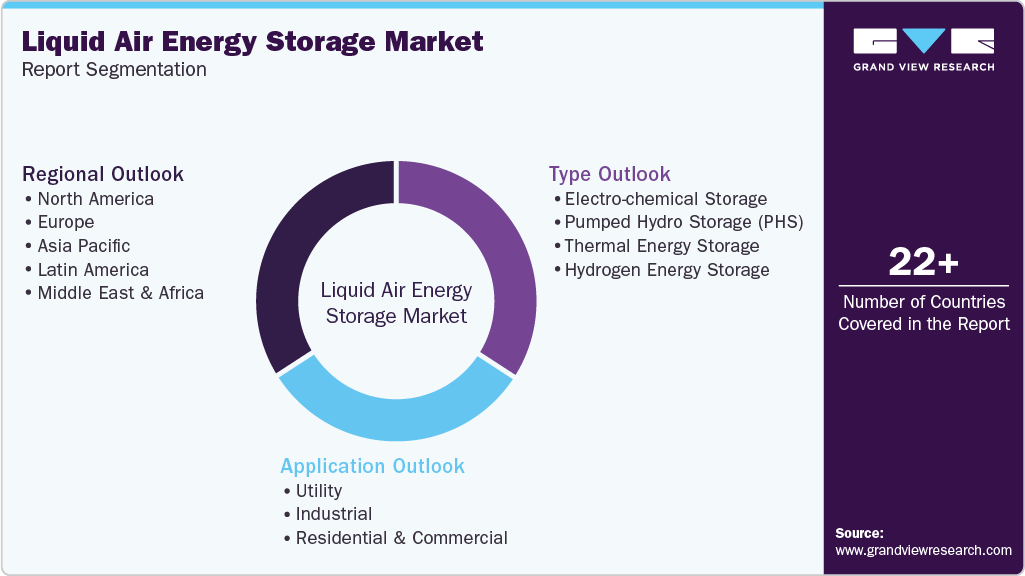
This report forecasts revenue growth at global, regional, and country levels and provides an analysis of the latest industry trends in each of the sub-segments from 2021 to 2033. For this study, Grand View Research has segmented the global liquid air energy storage market report on the basis of type, application and region:
-
Type Outlook (Revenue, USD Million, 2021 - 2033)
-
Electro-chemical Storage
-
Pumped Hydro Storage (PHS)
-
Thermal Energy Storage
-
Hydrogen Energy Storage
-
-
Application Outlook (Revenue, USD Million, 2021 - 2033)
-
Utility
-
Industrial
-
Residential & Commercial
-
-
Regional Outlook (Revenue, USD Million, 2021 - 2033)
-
North America
-
U.S.
-
Canada
-
Mexico
-
-
Europe
-
Germany
-
UK
-
France
-
-
Asia Pacific
-
China
-
India
-
Japan
-
South Korea
-
-
Latin America
-
Brazil
-
-
Middle East & Africa
-
Saudi Arabia
-
UAE
-
-
Frequently Asked Questions About This Report
b. The global liquid air energy storage market size was estimated at USD 1.30 billion in 2024 and is expected to reach USD 1.52 billion in 2025.
b. The global liquid air energy storage market is expected to grow at a compound annual growth rate of 17.8% from 2025 to 2033 to reach USD 5.67 billion by 2033.
b. Based on the type segment, Electro-chemical Storage held the largest revenue share of more than 62% in 2024.
b. Some of the key players operating in the liquid air energy storage (LAES) market include Highview Power, MAN Energy Solutions, General Electric (GE), Linde plc, Messer SE & Co. KGaA, Mitsubishi Hitachi Power Systems, Siemens Energy, Viridor, Heatric, and Atlas Copco.
b. The key factors driving the liquid air energy storage (LAES) market include the growing need to provide long-duration, large-scale energy storage solutions to support the integration of intermittent renewable energy sources such as wind and solar. Increasing electricity demand, grid modernization efforts, and commitments to decarbonize the power sector are prompting utilities and industrial users to adopt reliable storage technologies.


Share this report with your colleague or friend.
Need a Tailored Report?
Customize this report to your needs — add regions, segments, or data points, with 20% free customization.


ISO 9001:2015 & 27001:2022 Certified
We are GDPR and CCPA compliant! Your transaction & personal information is safe and secure. For more details, please read our privacy policy.
Trusted market insights - try a free sample
See how our reports are structured and why industry leaders rely on Grand View Research. Get a free sample or ask us to tailor this report to your needs.