Middle East Nanocoatings Market Summary
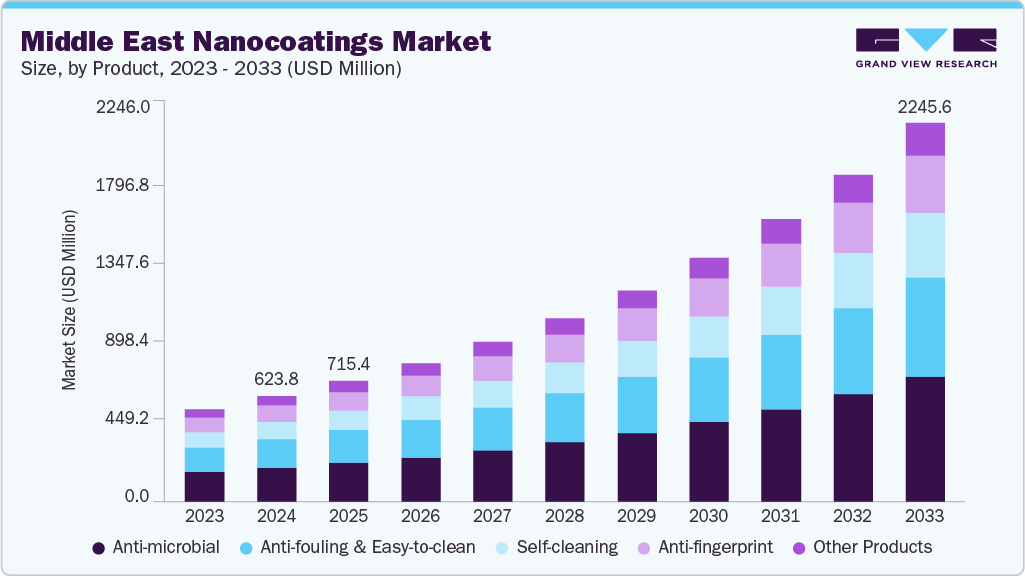
The Middle East nanocoatings market size was estimated at USD 623.8 million in 2024 and is projected to reach USD 2,245.6 million by 2033, growing at a CAGR of 15.4% from 2025 to 2033. The market is primarily driven by the rising demand for advanced surface protection solutions that enhance durability, hygiene, and energy efficiency across key sectors such as healthcare, food manufacturing, water treatment, and construction.
Key Market Trends & Insights
- By product, the anti-microbial segment dominated the market with the largest revenue share of 31.8% in 2024.
- By application, the medical & healthcare segment dominated the Middle East nanocoatings market in 2024 with a 14.9% share.
Market Size & Forecast
- 2024 Market Size: USD 623.8 Million
- 2033 Projected Market Size: USD 2,245.6 Million
- CAGR (2025-2033): 15.4%
Growing emphasis on antimicrobial and self-cleaning surfaces to meet stringent infection control and hygiene standards, coupled with increasing investments in large-scale infrastructure and renewable energy projects in Saudi Arabia, UAE, and Qatar, is accelerating adoption. The need to reduce maintenance costs, optimize operational efficiency, and comply with green building and sustainability regulations is fostering wider implementation of nanocoatings in both new installations and retrofit projects.
Opportunities are significant in expanding nanocoatings into emerging high-value applications such as photovoltaic anti-soiling solutions, water treatment membranes, and marine anti-fouling systems, especially in Saudi Arabia, the UAE, and Oman. The ongoing wave of smart city projects, healthcare infrastructure upgrades, and sustainability-focused retrofitting efforts provide strong growth potential. Additionally, the region’s focus on renewable energy and energy-efficient buildings opens doors for self-cleaning and thermal regulation coatings, while Israel’s strong R&D sector offers chances for specialized nanocoatings in medical devices, electronics, and advanced packaging. Partnering with regional EPCs, facility managers, and government-supported initiatives is likely to further boost market penetration.
The market encounters challenges due to high upfront costs compared to traditional coatings, which often cause resistance among price-sensitive customers. Limited standardization and the absence of region-specific performance benchmarks reduce trust and hinder large-scale adoption, especially in extreme Middle Eastern conditions characterized by high UV exposure, salinity, and dust. Additionally, the requirement for skilled applicators, proper surface preparation, and strict regulatory validation for antimicrobial claims complicate adoption. Concerns about the long-term durability of certain nanocoating formulations and increasing scrutiny of PFAS-based chemistries also limit widespread commercialization.
Market Concentration & Characteristics
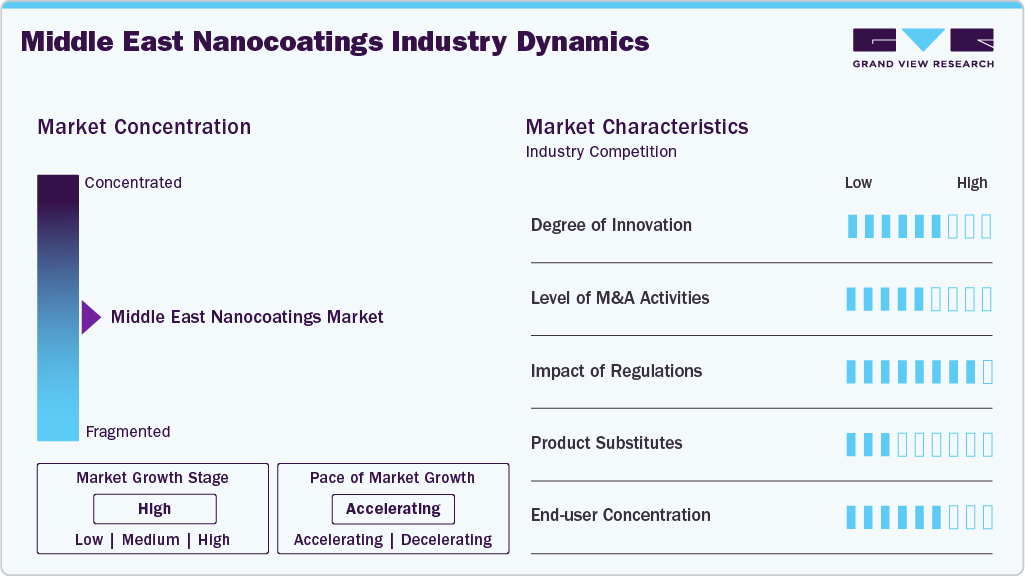
The Middle East nanocoatings market is moderately fragmented. It features a mix of global leaders, regional companies, and niche technology providers. Major players include PPG Industries, AkzoNobel N.V., Sherwin-Williams, Nanophase Technologies Corporation, Bio-Gate AG, Nanogate SE, and NEI Corporation, along with regional applicators and distributors serving specific sectors such as healthcare, construction, and renewable energy. These companies focus on delivering high-performance nanocoating solutions designed for the Middle Eastern environment, such as anti-microbial, self-cleaning, and anti-fouling products for infrastructure, water treatment, and energy projects. Their leadership in the market is supported by strong distribution networks, partnerships with local applicators, and adherence to regional standards such as LEED, Estidama, and Mostadam.
To strengthen their market position, leading companies are adopting strategies such as product innovation, focusing on PFAS-free and environmentally compliant formulations, and expanding their portfolios for high-growth applications like PV anti-soiling and marine anti-fouling. Strategic collaborations with EPC contractors, facility management companies, and government-backed initiatives are being leveraged to secure specifications in large-scale infrastructure and retrofit projects across Saudi Arabia and the UAE. Additionally, these players are investing in localized field testing, pilot projects, and training programs for certified applicators to ensure performance validation under harsh climatic conditions. Mergers, acquisitions, and partnerships with regional nanotechnology start-ups are also emerging as key moves to enhance technological capabilities and expand geographic reach in the Middle East market.
Product Insights
The anti-microbial segment accounted for the largest revenue share of 31.8% in 2024, owing to the rising demand for hygiene and infection control solutions across critical sectors such as healthcare, food manufacturing, packaging, and public infrastructure. Heightened awareness following regional health and safety initiatives, coupled with stringent regulations for contamination control in medical facilities and food processing plants, has driven significant adoption. These coatings, often utilizing silver, copper, or zinc-based nanoparticles, effectively reduce microbial growth on high-touch surfaces, thereby minimizing operational downtime and ensuring compliance with international safety standards. Their ability to offer long-lasting protection while reducing the frequency of disinfection procedures further strengthens their market presence in both new installations and retrofit projects across Saudi Arabia, UAE, and Qatar.
Beyond antimicrobial coatings, the Middle East market is seeing a growing use of other nanocoating products tailored to regional needs. Anti-fouling and easy-to-clean coatings are becoming popular in marine, water treatment, and industrial utilities to reduce biofilm, scale, and dirt buildup, which lowers maintenance costs and boosts operational efficiency. Self-cleaning coatings, especially those based on TiO₂, are widely used on building facades and solar panels to prevent dust and sand buildup, leading to higher energy output and less water used for cleaning. Anti-fingerprint coatings are mainly used in electronics, luxury interiors, and appliances to improve appearance and make maintenance easier. Other products, such as thermal control, anti-corrosion, and barrier coatings, meet the specific needs of infrastructure, oil & gas, and packaging industries.
Application Insights
The medical & healthcare segment dominated the Middle East nanocoatings market in 2024 with a 14.9% share, mainly due to the growing need for antimicrobial and easy-to-clean coatings in hospitals, clinics, laboratories, and pharmaceutical manufacturing facilities. Increased investments in upgrading healthcare infrastructure across Saudi Arabia, UAE, and Qatar, along with strict infection control regulations, have boosted adoption. Nanocoatings in this sector help reduce the spread of pathogens on high-touch surfaces, medical devices, and surgical instruments, enhancing patient safety and meeting international standards such as ISO 22196 and JIS Z 2801.
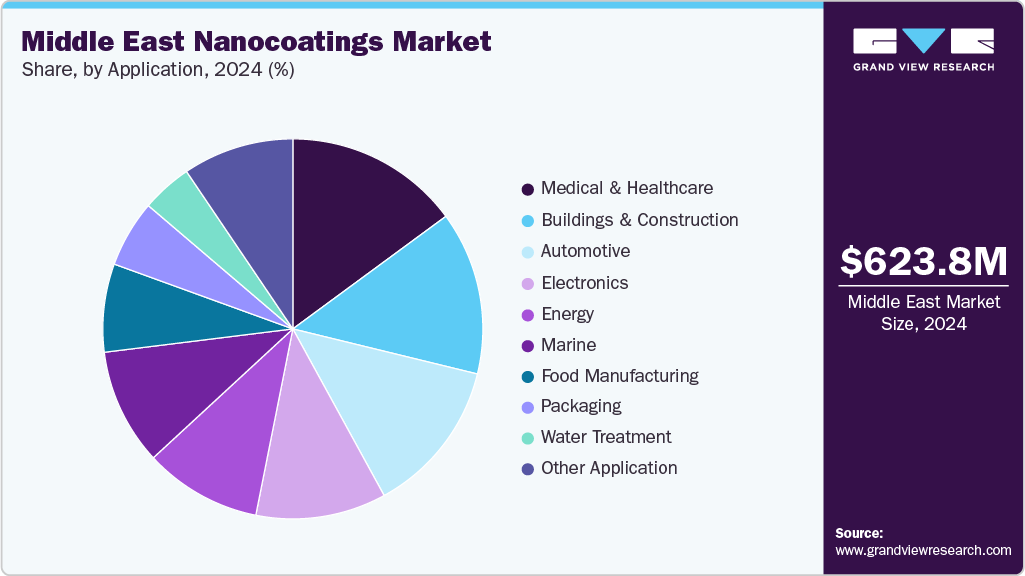
Beyond healthcare, nanocoatings are increasingly used across various sectors in the Middle East. Food manufacturing and packaging industries employ antimicrobial and barrier coatings to improve product safety and extend shelf life, while marine and water treatment sectors benefit from anti-fouling and anti-scaling solutions to decrease biofilm formation and reduce operational downtime. In the buildings and construction sector, self-cleaning and anti-corrosion coatings are widely used on façades, HVAC systems, and infrastructure exposed to tough desert conditions, whereas the energy industry uses anti-soiling coatings to boost photovoltaic efficiency. Electronics and automotive industries are adopting anti-fingerprint, scratch-resistant, and hydrophobic coatings to improve durability and appearance, while other applications include specialized uses in oil and gas, public infrastructure, and high-performance industrial utilities.
Country Insights
The Middle East nanocoatings market is experiencing steady growth driven by the region’s focus on infrastructure modernization, sustainable construction practices, and enhanced asset protection in sectors such as healthcare, energy, water treatment, and marine. Countries including the UAE, Qatar, Oman, and Kuwait are actively adopting self-cleaning, anti-fouling, and antimicrobial coatings to reduce maintenance costs, improve operational efficiency, and comply with international hygiene and sustainability standards. Large-scale investments in renewable energy projects, hospitality, and smart city developments are creating a strong demand for advanced coatings that can withstand the region’s challenging climate, characterized by high UV exposure, sand, and salinity. Moreover, the growing emphasis on ESG compliance and lifecycle cost optimization is pushing both government and private sectors to integrate nanocoatings into retrofit and new-build projects.
Saudi Arabia Nanocoatings Market Trends
Saudi Arabia leads the Middle East nanocoatings market, driven by major investments under the Vision 2030 initiative, which aims to diversify the economy and improve infrastructure in healthcare, energy, and industry. The country is seeing strong adoption of antimicrobial coatings in hospitals, clinics, and pharmaceutical facilities, along with increasing use of self-cleaning and anti-soiling solutions in solar projects to boost photovoltaic efficiency. The expansion of desalination plants, ports, and marine infrastructure further fuels demand for anti-fouling and corrosion-resistant coatings. Moreover, government-supported green building programs like Mostadam, combined with strict hygiene and operational efficiency standards in both public and private sectors, create a positive environment for market growth. Saudi Arabia’s focus on local field trials, strategic partnerships, and performance warranties also make it the most promising market for global and regional players.
Key Middle East Nanocoatings Company Insights
Some of the key players operating in the Middle East Nanocoatings market include PPG Industries, AkzoNobel N.V., Sherwin-Williams, Nanophase Technologies Corporation, and Bio-Gate AG.
-
PPG Industries is a leading global supplier of paints, coatings, and specialty materials, with a growing presence in the Middle East nanocoatings market. The company leverages its extensive research and development capabilities to deliver advanced antimicrobial, self-cleaning, and corrosion-resistant nanocoating solutions tailored for critical sectors such as healthcare, energy, marine, and construction. PPG focuses on developing high-performance, environmentally compliant, and PFAS-free formulations that align with regional sustainability and hygiene standards, including LEED and Estidama certifications. Through strategic collaborations with regional distributors, EPC contractors, and facility managers, the company strengthens its market penetration, particularly in Saudi Arabia and the UAE, where large-scale infrastructure, renewable energy, and healthcare projects drive demand for innovative surface protection technologies.
Key Middle East Nanocoatings Companies:
- PPG Industries
- AkzoNobel N.V.
- Sherwin-Williams
- Nanophase Technologies Corporation
- Bio-Gate AG
- Nanogate SE
- NEI Corporation
- Tesla NanoCoatings, Inc.
- actnano
- P2i Ltd
Middle East Nanocoatings Market Report Scope
|
Report Attribute
|
Details
|
|
Market size value in 2025
|
USD 715.4 million
|
|
Revenue forecast in 2033
|
USD 2,245.6 million
|
|
Growth rate
|
CAGR of 15.4% from 2025 to 2033
|
|
Base year for estimation
|
2024
|
|
Historical data
|
2018 - 2023
|
|
Forecast period
|
2025 - 2033
|
|
Quantitative units
|
Revenue in USD million/billion, Volume in Kilotons, and CAGR from 2025 to 2033
|
|
Report coverage
|
Volume & revenue forecast, company ranking, competitive landscape, growth factors, and trends
|
|
Segments covered
|
Product, application, country
|
|
Country scope
|
Oman; Kuwait; Saudi Arabia; UAE; Qatar; Bahrain; Isael; Rest of Middle East
|
|
Key companies profiled
|
PPG Industries; AkzoNobel N.V.; Sherwin-Williams; Nanophase Technologies Corporation; Bio-Gate AG; Nanogate SE; NEI Corporation; Tesla NanoCoatings, Inc.; actnano; P2i Ltd
|
|
Customization scope
|
Free report customization (equivalent to up to 8 analysts’ working days) with purchase. Addition or alteration to country, regional & segment scope.
|
|
Pricing and purchase options
|
Avail customized purchase options to meet your exact research needs. Explore purchase options
|
Middle East Nanocoatings Market Report Segmentation
This report forecasts revenue growth at global, regional, and country levels and provides an analysis of the latest industry trends in each of the sub-segments from 2018 to 2033. For this study, Grand View Research has segmented the Middle East nanocoatings market report based on product, application, and country:
-
Product Outlook (Revenue, USD Billion; Volume, Kilotons; 2018 - 2033)
-
Application Outlook (Revenue, USD Billion; Volume, Kilotons; 2018 - 2033)
-
Medical & Healthcare
-
Food Manufacturing
-
Packaging
-
Marine
-
Water Treatment
-
Electronics
-
Buildings & Construction
-
Automotive
-
Energy
-
Other Applications
-
Country Outlook (Revenue, USD Billion; Volume, Kilotons; 2018 - 2033)
-
Oman
-
Kuwait
-
Saudi Arabia
-
UAE
-
Qatar
-
Bahrain
-
Israel
-
Rest of Middle East
Frequently Asked Questions About This Report
b. The anti-microbial segment dominated the market in 2024 due to increasing demand for infection control solutions across healthcare, food processing, and public infrastructure, driven by stringent hygiene regulations and rising investments in contamination-free environments. Its ability to reduce microbial growth and lower maintenance requirements further strengthened its market position.
b. Some of the key players operating in the Middle East Nanocoatings market include PPG Industries, AkzoNobel N.V., Sherwin-Williams, Nanophase Technologies Corporation, Bio-Gate AG, Nanogate SE, NEI Corporation, Tesla NanoCoatings, Inc., actnano, and P2i Ltd.
b. The Middle East nanocoatings market is driven by growing demand for advanced surface protection solutions that enhance hygiene, durability, and energy efficiency, particularly across healthcare, renewable energy, and water treatment sectors. Additionally, increasing infrastructure investments and stringent sustainability regulations are accelerating adoption in both new construction and retrofit projects.
b. The Middle East nanocoatings market size was estimated at USD 623.8 million in 2024 and is expected to reach USD 715.4 million in 2025.
b. The Middle East nanocoatings market is expected to grow at a compound annual growth rate of 15.4% from 2025 to 2033 to reach USD 2,245.6 million by 2033.

 Download Sample Report