Sodium Sulfide Market Summary
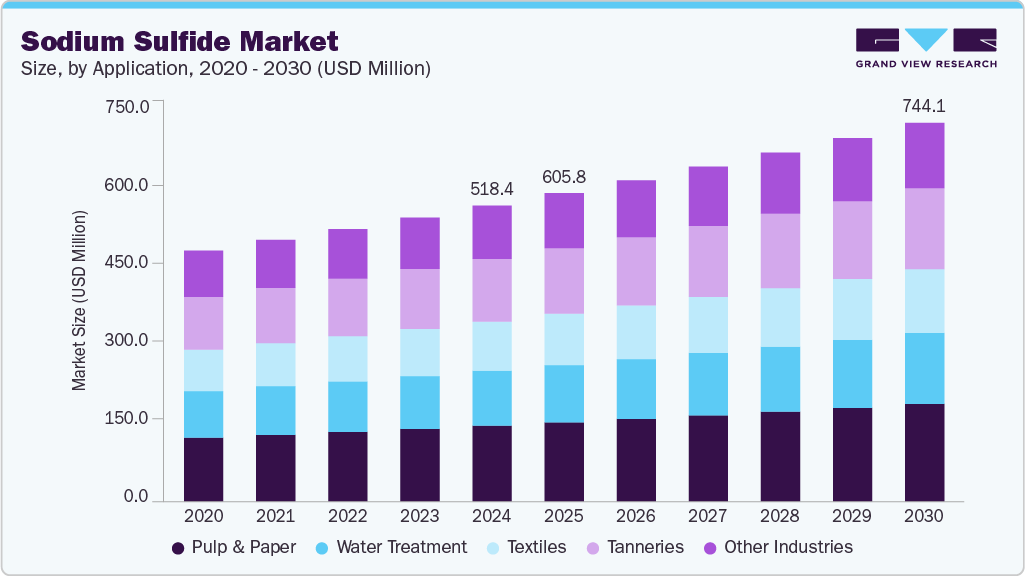
The global sodium sulfide market size was estimated at USD 518.4 million in 2024, and is projected to reach USD 744.11 million by 2030, growing at a CAGR of 4.2% from 2025 to 2030. The market growth is primarily driven by increasing demand from the pulp and paper industry and expanding usage in water treatment, leather processing, and textile manufacturing.
Key Market Trends & Insights
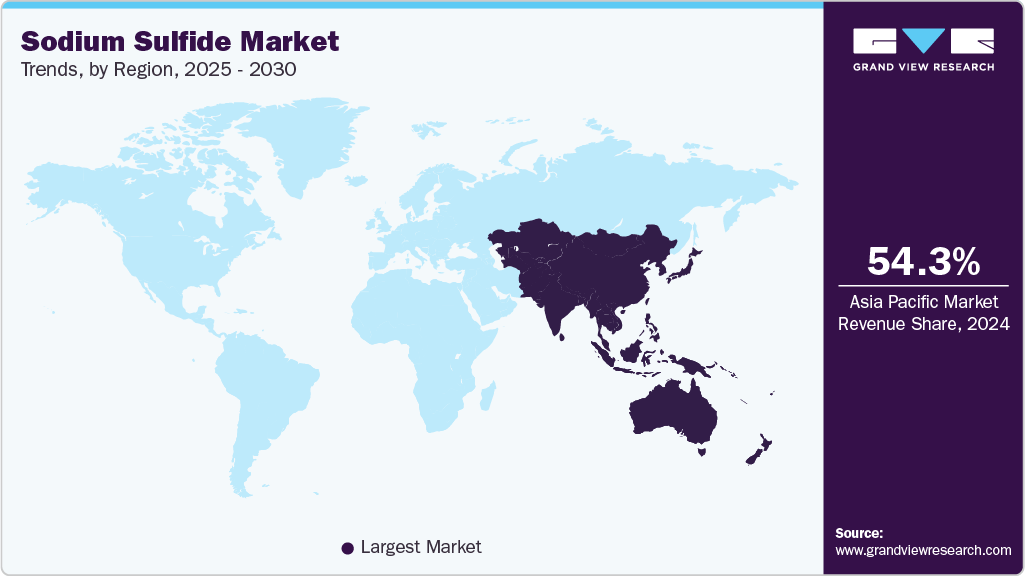
- Asia Pacific dominates the global sodium sulfide market, with a 54.3% market share in 2024.
- The sodium sulfide market in China is the leading producer and consumer of sodium sulfide globally.
- By application, the pulp and paper segment led the market and accounted for the largest revenue share of 25.67% in 2024.
- By product, the anhydrous segment led the market with the largest revenue share of 47.5% in 2024.
Market Size & Forecast
- 2024 Market Size: USD 518.4 Million
- 2030 Projected Market Size: USD 744.11 Million
- CAGR (2025-2030): 4.2%
- Asia Pacific: Largest market in 2024
Sodium sulfide is valued for its strong reducing properties, making it essential in dehairing, bleaching, deinking, and metal recovery processes. As global environmental standards tighten, sodium sulfide manufacturers increasingly invest in cleaner production methods and advanced packaging technologies to mitigate leakage and emissions risks. This transition to safer handling practices is expected to drive innovation in containment, transportation, and waste management solutions for sulfide-based chemicals.
The market is also witnessing significant traction in emerging economies where rising industrialization and infrastructure development lead to higher consumption in key end-use industries. Southeast Asia, in particular, is experiencing an upsurge in demand as local manufacturing scales up across the textile, pulp, and tanning sectors. This regional dynamism is expected to create new opportunities for suppliers and distributors.
Furthermore, advancements in product customization and the availability of different purity grades enhance the compound’s adaptability to niche applications. With manufacturers offering tailored specifications such as low ferric and high-purity variants, end users across pharmaceuticals, electronics, and specialty chemical segments increasingly turn to sodium sulfide for precise, high-performance formulations.
Market Concentration & Characteristics
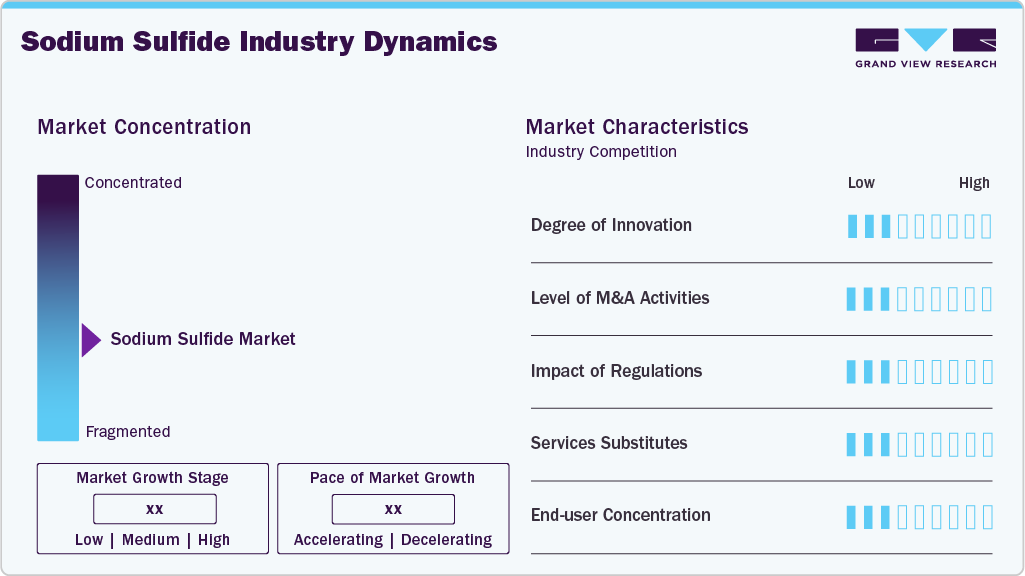
The sodium sulfide industry is moderately fragmented, with a mix of multinational chemical corporations and regional manufacturers serving industry-specific needs. Key market characteristics include bulk production, direct industry integration, and varying purity requirements depending on application.
Producers focus on consistent quality control, competitive pricing, and logistics optimization to ensure timely supply, especially in pulp and leather manufacturing hubs. Due to the chemical’s toxic and corrosive nature, transportation and storage regulations are stringent, creating entry barriers for new participants. Long-term contracts and customized grades (such as low ferric sodium sulfide) maintain customer loyalty and ensure supply reliability.
In recent years, companies have been increasingly focused on establishing regional production hubs and distribution alliances to minimize transportation risks and meet just-in-time delivery demands. This strategy is particularly crucial in countries with strict chemical handling regulations or limited access to bromine-derived raw materials.
The market also reflects a trend toward backward integration, with major players investing in captive bromine production and upstream procurement to secure raw material availability and manage cost volatility. This vertical integration helps streamline operations, improve profitability, and insulate companies from supply chain disruptions.
In addition, sustainability and compliance are emerging as competitive differentiators. Manufacturers are developing low-emission production technologies, obtaining environmental certifications, and adopting green chemistry principles to appeal to environmentally conscious buyers and adhere to tightening regulations worldwide.
Application Insights
The pulp and paper segment led the market and accounted for the largest revenue share of 25.67% in 2024. Sodium sulfide plays a key role in kraft pulping processes by breaking down lignin bonds and facilitating fiber separation. Its effectiveness in the deinking and bleaching processes supports its widespread use in the paper recycling sector. As sustainability and recycling efforts increase globally, demand from the pulp and paper segment is expected to remain stable or grow.
In water treatment, sodium sulfide is used as a reducing agent to remove heavy metals and treat wastewater with high oxygen demand. Industries such as electroplating, mining, and chemical manufacturing use sodium sulfide to ensure compliance with discharge standards. Stricter environmental regulations globally are driving their adoption in this segment.
Sodium sulfide is widely used in textile dyeing and finishing processes, especially for sulfur-based dyes. It helps to reduce dye compounds and enhance color fastness. Growth in textile production in Asia Pacific, particularly India, Bangladesh, and Vietnam, bolsters demand for sodium sulfide in this application. The compound is crucial in leather processing for dehairing hides and softening animal skins. The tanning industry, especially in countries like China, Brazil, and Italy, continues to consume a substantial share of sodium sulfide due to its reliability and effectiveness.
Product Insights
The anhydrous segment led the market with the largest revenue share of 47.5% in 2024. Anhydrous sodium sulfide holds a notable share of the global market due to its high reactivity and widespread use in organic chemical synthesis and heavy-duty industrial processes. It is predominantly used in applications requiring high purity and efficiency, such as in synthetic dye production and some mining operations. However, its handling complexities require specialized equipment and safety protocols.
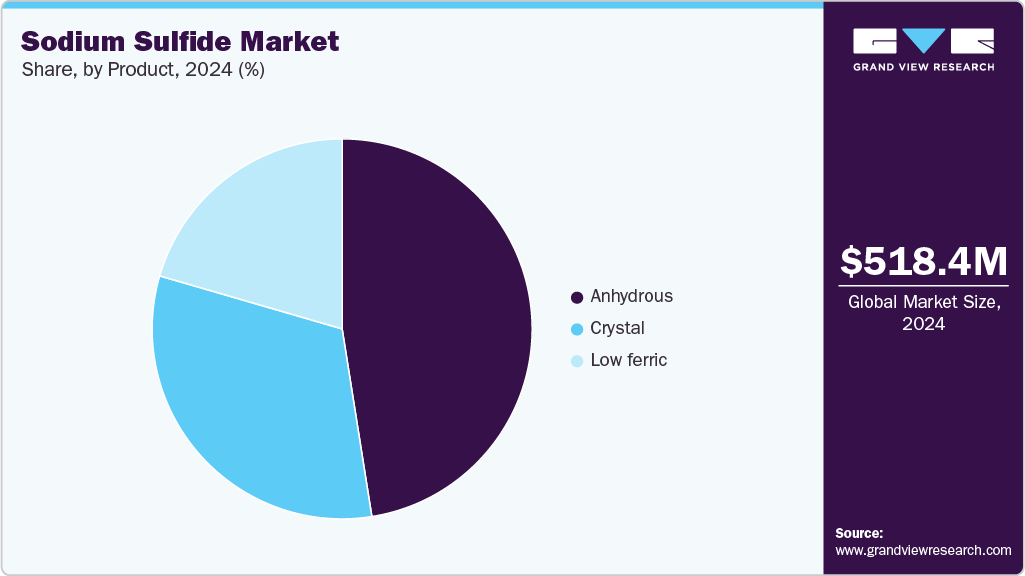
Crystal sodium sulfide is the most commonly produced and commercially traded form, widely used in tanning, textiles, and paper industries. It offers ease of handling, better solubility, and cost advantages over other forms. This segment benefits from rising demand in emerging economies where these industries are scaling up production. Low ferric sodium sulfide is preferred in sensitive applications like electronics-grade chemicals and high-quality leather processing, where iron contamination must be minimized. Its premium pricing and limited production make it a niche but vital product for quality-conscious end users.
Regional Insights
Asia Pacific dominates the global sodium sulfide market, with a 54.3% market share in 2024, with China and India as the largest producers and consumers. The region’s robust paper, leather, and textiles manufacturing base ensures consistent demand. Government-backed industrial expansion, favorable raw material availability, and lower production costs enhance the region’s leadership.
China Sodium Sulfide Market Trends
The sodium sulfide market in China is the leading producer and consumer of sodium sulfide globally, driven by its massive leather processing, textile, and pulp & paper industries. The country houses several large-scale manufacturers with vertically integrated operations that allow cost-efficient and high-volume production. In addition to serving robust domestic demand, China is also a key exporter to other Asian markets and beyond.
North America Sodium Sulfide Market Trends
The sodium sulfide market in North America is characterized by demand from the pulp & paper, mining, and water treatment sectors. Strict safety and environmental regulations in the U.S. and Canada drive investments in safe handling infrastructure and product innovation, such as low ferric grades.
Europe Sodium Sulfide Market Trends
The sodium sulfide market in Europe maintains a mature profile, driven by demand from sustainable paper recycling, tanning, and chemical industries. Regulatory compliance influences product formulation and supplier selection, especially regarding REACH and wastewater discharge limits.
Latin America Sodium Sulfide Market Trends
The sodium sulfide market in Latin America is controlled by Brazil and Argentina, which are notable contributors to Latin America's sodium sulfide consumption, mainly in the leather and mining sectors. The region's economic growth and rising industrial output are expected to support moderate market expansion.
Middle East & Africa Sodium Sulfide Market Trends
The sodium sulfide market in the MEA is emerging, with rising demand from water treatment, mining, and textiles. Growing urbanization and industrialization in South Africa, Egypt, and Saudi Arabia are expected to drive future market penetration.
Key Sodium Sulfide Company Insights
Some of the key market players include Solvay, Nippon Chemical Industrial Co., Ltd., Tessenderlo Group, Sichuan Shenhong Chemical Industry Co., Ltd., and NaFine Chemical Industry Group Co., Ltd.
-
Solvay is a prominent multinational chemical manufacturer headquartered in Belgium, known for producing a broad spectrum of specialty and industrial chemicals. Solvay specializes in high-purity grades designed for critical industrial applications, including water treatment, mining, and pulp and paper in the sodium sulfide industry. The company emphasizes environmentally responsible production and has implemented robust waste handling and emissions control systems across its facilities. Solvay's global supply network and consistent product quality make it a preferred partner for customers with demanding regulatory and performance standards, particularly in Europe and North America.
-
Based in Japan, Nippon Chemical Industrial is renowned for its expertise in producing ultra-pure and low ferric sodium sulfide for specialized applications in electronics, semiconductors, and high-end leather processing. The company maintains strict quality assurance protocols and invests significantly in R&D to meet the stringent standards of industries requiring extremely low metal contamination levels. Its focus on innovation and precision manufacturing allows it to cater to niche segments that demand exceptional chemical consistency and purity. Nippon Chemical also exports to Southeast Asia and Western markets, leveraging Japan’s reputation for technological reliability and chemical safety compliance.
Key Sodium Sulfide Companies:
The following are the leading companies in the sodium sulfide market. These companies collectively hold the largest market share and dictate industry trends.
- Solvay S.A.
- Nippon Chemical Industrial Co., Ltd.
- TIB Chemicals AG
- Rongyuan Chemical Co., Ltd.
- Gujarat Alkalies and Chemicals Ltd (GACL)
- Shaanxi Fuhua Chemical Co., Ltd.
- Weifang Yidu Chemical Co., Ltd.
- Tessenderlo Group
- Sichuan Shenhong Chemical Industry Co., Ltd.
- NaFine Chemical Industry Group Co., Ltd.
Recent Developments
-
In January 2025, VitaTek entered into a strategic agreement with Chamfr to launch its VitaCoat hydrophilic coatings on the Chamfr marketplace, making them accessible to engineers globally.
-
In March 2024, Grillo-Werke AG announced capacity expansion at its sodium sulfide production site in Rheinberg, Germany, to address rising demand from Europe's pulp & paper and water treatment industries.
Sodium Sulfide Market Report Scope
|
Report Attribute
|
Details
|
|
Market size value in 2025
|
USD 605.8 million
|
|
Revenue forecast in 2030
|
USD 744.11 million
|
|
Growth rate
|
CAGR of 4.2% from 2025 to 2030
|
|
Base year for estimation
|
2024
|
|
Historical data
|
2018 - 2023
|
|
Forecast period
|
2025 - 2030
|
|
Quantitative units
|
Revenue in USD million/billion and CAGR from 2025 to 2030
|
|
Report coverage
|
Revenue forecast, company ranking, competitive landscape, growth factors, and trends
|
|
Segments covered
|
Product, application, region
|
|
Regional scope
|
North America; Europe; Asia Pacific; Central & South America; Middle East & Africa
|
|
Country scope
|
U.S.; Canada; Mexico; UK; Germany; France; Italy; Spain; China; India; Japan; South Korea
|
|
Key companies profiled
|
Solvay S.A.; Nippon Chemical Industrial Co., Ltd.; TIB Chemicals AG; Rongyuan Chemical Co., Ltd.; Gujarat Alkalies and Chemicals Ltd (GACL); Shaanxi Fuhua Chemical Co., Ltd.; Weifang Yidu Chemical Co., Ltd.; Tessenderlo Group; Sichuan Shenhong Chemical Industry Co., Ltd.; NaFine Chemical Industry Group Co., Ltd.
|
|
Customization scope
|
Free report customization (equivalent up to 8 analysts’ working days) with purchase. Addition or alteration to country, regional & segment scope.
|
|
Pricing and purchase options
|
Avail customized purchase options to meet your exact research needs. Explore purchase options
|
Global Sodium Sulfide Market Report Segmentation
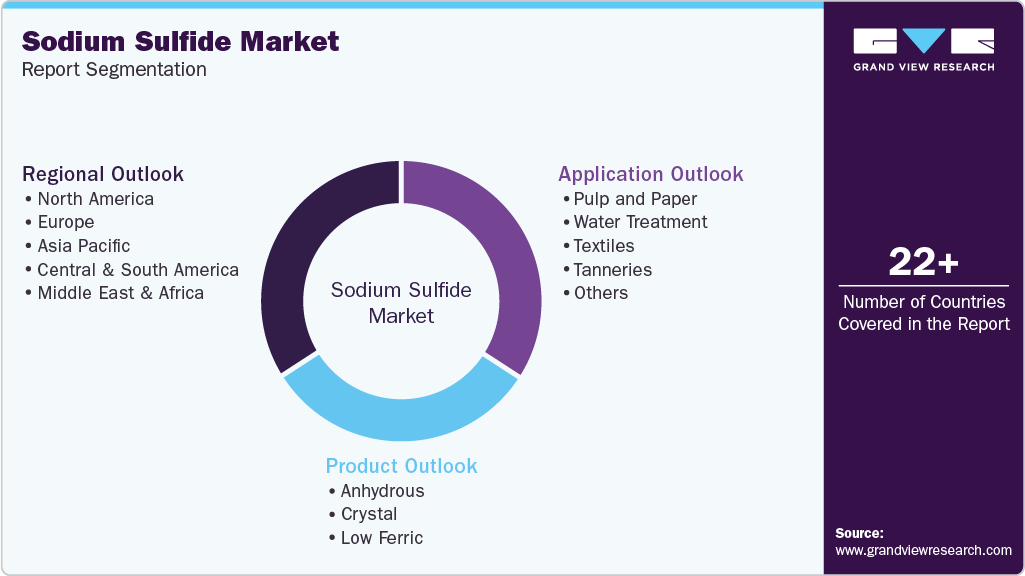
This report forecasts volume & revenue growth at the global, regional, and country levels and provides an analysis of the latest industry trends in each of the sub-segments from 2018 to 2030. For this study, Grand View Research has segmented the global sodium sulfide market report based on product, application, and region.
-
Product Outlook (Volume, Kilotons; Revenue, USD Million, 2018 - 2030)
-
Anhydrous
-
Crystal
-
Low Ferric
-
Application Outlook (Volume, Kilotons; Revenue, USD Million, 2018 - 2030)
-
Pulp and Paper
-
Water Treatment
-
Textiles
-
Tanneries
-
Others
-
Regional Outlook (Volume, Kilotons; Revenue, USD Million, 2018 - 2030)
-
North America
-
Europe
-
Germany
-
UK
-
France
-
Italy
-
Spain
-
Asia Pacific
-
China
-
India
-
Japan
-
South Korea
-
Central & South America
-
Middle East & Africa
Frequently Asked Questions About This Report
b. The global sodium sulfide market size was estimated at USD 518.4 million in 2024.
b. The global sodium sulfide projected to grow at a CAGR of 4.2% from 2025 to 2030.
b. Asia Pacific dominates the global sodium sulfide market with 54.3% market share in 2024. China and India as the largest producers and consumers. The region’s robust manufacturing base for paper, leather, and textiles ensures consistent demand. Government-backed industrial expansion, favorable raw material availability, and lower production costs enhance the region’s leadership.
b. Some key players operating in the sodium sulfide market include Solvay S.A., Nippon Chemical Industrial Co., Ltd., TIB Chemicals AG, Rongyuan Chemical Co., Ltd., Gujarat Alkalies and Chemicals Ltd (GACL), Shaanxi Fuhua Chemical Co., Ltd., Weifang Yidu Chemical Co., Ltd., Tessenderlo Group, Sichuan Shenhong Chemical Industry Co., Ltd., NaFine Chemical Industry Group Co., Ltd.,
b. . The market growth is primarily driven by increasing demand from the pulp and paper industry, as well as expanding usage in water treatment, leather processing, and textile manufacturing.

 Download Sample Report