- Home
- »
- Agrochemicals & Fertilizers
- »
-
Soil Health Management Market Size, Industry Report, 2033GVR Report cover
![Soil Health Management Market Size, Share & Trends Report]()
Soil Health Management Market (2025 - 2033) Size, Share & Trends Analysis Report By Product (Organic Amendments, Soil Conditioners & Fertility Enhancers), By Application (Agriculture, Research & Environmental Monitoring), By Region, And Segment Forecasts
- Report ID: GVR-4-68040-797-8
- Number of Report Pages: 80
- Format: PDF
- Historical Range: 2018 - 2023
- Forecast Period: 2025 - 2033
- Industry: Bulk Chemicals
- Report Summary
- Table of Contents
- Segmentation
- Methodology
- Download FREE Sample
-
 Download Sample Report
Soil Health Management Market Summary
The global soil health management market size was estimated at USD 14.70 billion in 2024 and is projected to reach USD 31.95 billion by 2033, growing at a CAGR of 9.2% from 2025 to 2033. The market growth is driven due to the global shift toward sustainable and regenerative agriculture.
Key Market Trends & Insights
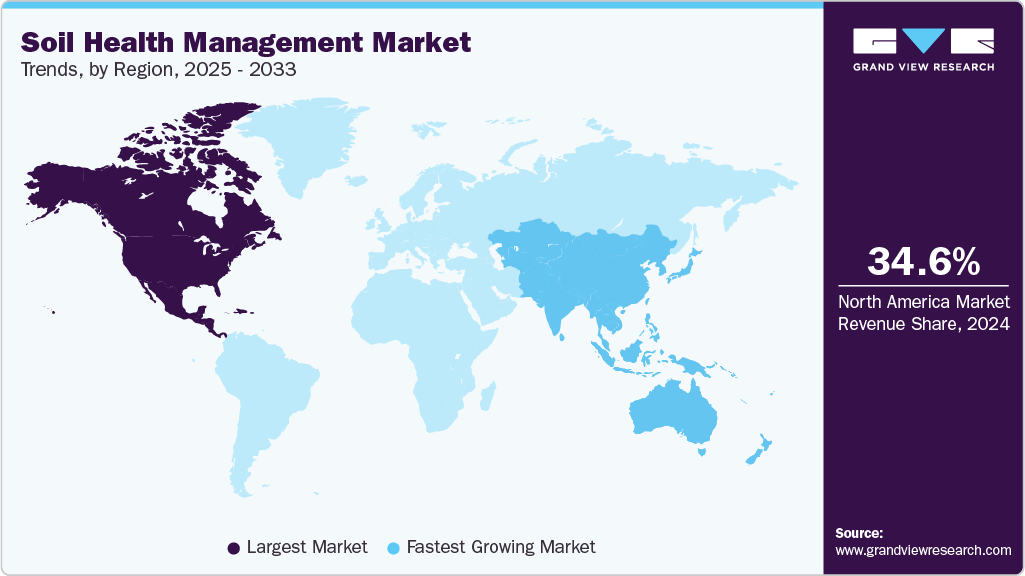
- North America dominated the global soil health management market with the largest revenue share of 34.6% in 2024.
- The U.S. soil health management industry is expected to grow at a substantial CAGR of 7.3% from 2025 to 2033.
- By product, the organic amendments segment held the highest market share of 37.6% in 2024 in terms of revenue.
- By application, the research & environmental monitoring segment is expected to grow at a fastast CAGR of 13.7% from 2025 to 2033 in terms of revenue.
Market Size & Forecast
- 2024 Market Size: USD 14.70 Billion
- 2033 Projected Market Size: USD 31.95 Billion
- CAGR (2025-2033): 9.2%
- North America: Largest market in 2024
- Asia Pacific: Fastest growing market
Increasing concerns over soil degradation, nutrient depletion, and declining fertility levels have prompted governments and farmers to adopt practices that improve long-term soil productivity. Techniques such as crop rotation, organic amendments, and reduced chemical dependency are gaining prominence, supported by policy incentives and international sustainability programs.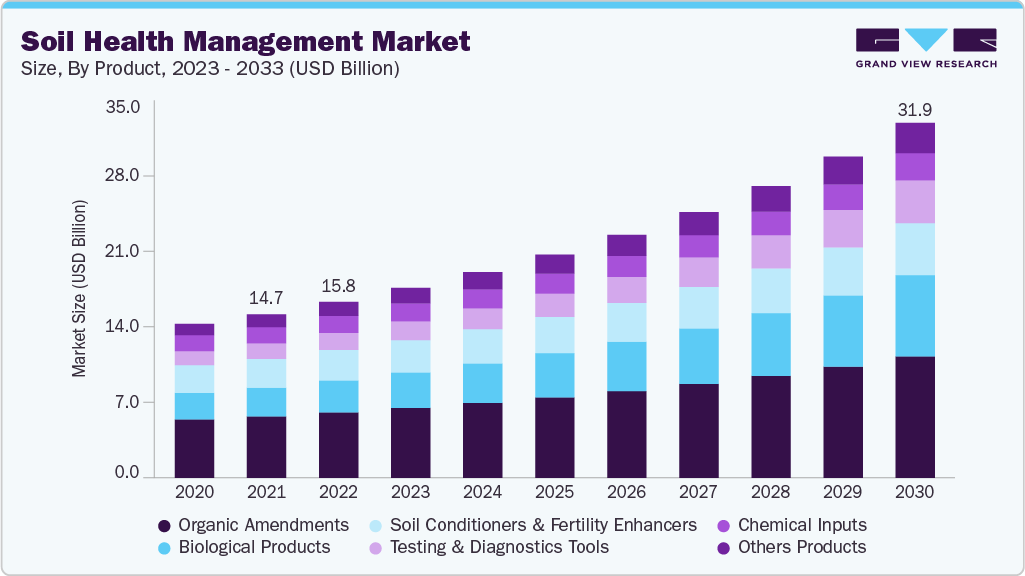
Governments across major agricultural economies are increasingly implementing subsidy schemes, awareness campaigns, and soil health missions to promote soil restoration and monitoring. For instance, India’s Soil Health Card Scheme and the EU’s Common Agricultural Policy (CAP) reforms emphasize the importance of maintaining soil fertility and reducing chemical runoff. Similarly, the U.S. Department of Agriculture (USDA) supports precision soil testing and conservation initiatives. These policy-driven measures are accelerating the adoption of soil testing kits, fertility enhancers, and organic amendments, thereby fueling market growth across both developed and emerging regions.
Rapid innovation in soil analysis and monitoring technologies is another key driver shaping the soil health management industry. The integration of remote sensing, GIS mapping, and IoT-based soil sensors allows for real-time assessment of soil moisture, nutrient levels, and microbial activity. These technologies enable farmers and agronomists to make data-driven decisions to optimize fertilizer usage and improve crop yields. The increasing use of digital soil management platforms by agritech companies and cooperatives has enhanced accessibility and affordability, especially for small and medium-scale farmers, thereby supporting market expansion.
The rising preference for biological soil enhancers and organic amendments is further propelling market demand. Consumers’ growing awareness of food safety and environmental impact has encouraged farmers to replace synthetic chemicals with bio-based alternatives that improve soil structure and microbial balance. Biological products such as compost, biochar, and microbial inoculants enhance soil carbon content and water retention capacity, improving long-term soil vitality. As global organic farming acreage continues to expand, the demand for sustainable soil health management products and solutions is expected to grow steadily through 2033.
Market Concentration & Characteristics
The soil health management market is moderately fragmented, comprising a mix of multinational agrochemical corporations, biological product manufacturers, and regional players specializing in soil diagnostics and conditioners. Established firms such as BASF SE, UPL Limited, Bayer AG, and Corteva Agriscience hold notable market shares owing to their extensive product portfolios and strong distribution networks. At the same time, a growing number of niche companies and start-ups are entering the market, focusing on bio-based soil enhancers, microbial inoculants, and digital soil monitoring solutions. This combination of global corporations and specialized innovators has led to a competitive yet diversified market landscape.
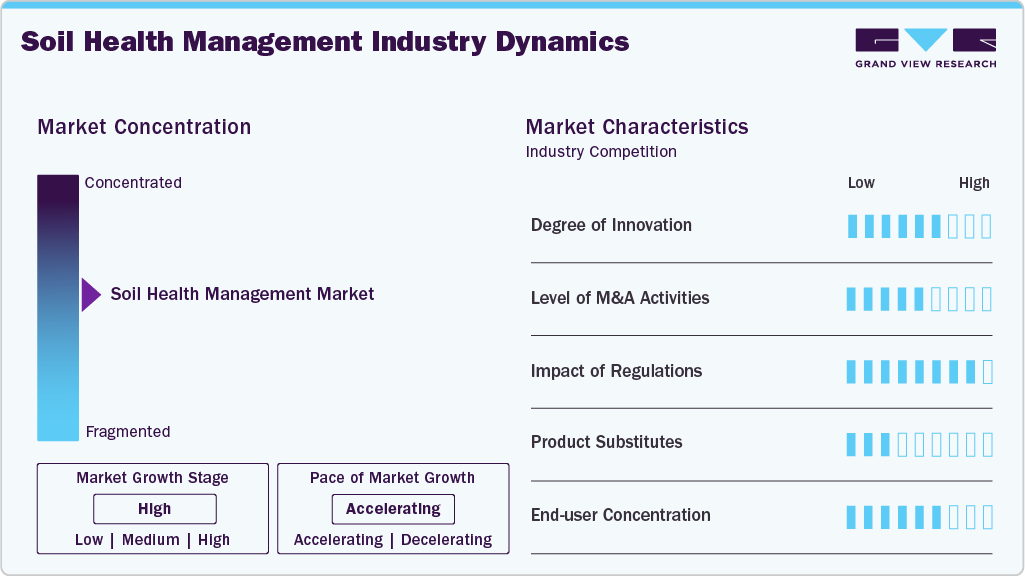
Despite the presence of several players, technological differentiation and regional specialization create moderate concentration within specific segments. Companies with expertise in precision agriculture technologies and biological formulations maintain a competitive advantage through integrated offerings that combine diagnostics with soil enhancement products. Strategic collaborations between agritech firms, research institutions, and governments are becoming more common, supporting innovation and scalability. As sustainability standards and digitalization continue to shape the agricultural sector, the market is expected to remain moderately concentrated, with consolidation likely in high-growth areas such as biological products and soil data analytics
Products Insights
The organic amendments segment led the soil health management industry with the largest revenue share of 37.6% in 2024. This includes compost, manure, and biochar, play a critical role in improving soil structure, moisture retention, and nutrient balance. They enhance microbial activity and organic carbon content, which are essential for maintaining long-term soil fertility. The growing shift toward sustainable and regenerative farming practices has significantly increased the demand for organic amendments as a natural alternative to chemical fertilizers.
The biological products segment is anticipated to grow at the fastest CAGR of 12.4% during the forecast period. This include biofertilizers, biostimulants, and microbial inoculants that promote soil health by enhancing nutrient uptake and restoring microbial diversity. These products support eco-friendly farming by reducing dependency on synthetic inputs and improving crop resilience to stress. The expanding organic farming acreage and global emphasis on soil biodiversity are driving strong growth in this segment.
Application Insights
The agriculture segment led the soil health management market with the largest revenue share of 55.8% in 2024, driven by the need to improve crop yield and soil fertility. Farmers increasingly rely on soil testing, conditioners, and bio-based products to optimize nutrient management and reduce degradation. The adoption of precision agriculture technologies further supports efficient and sustainable soil management practices across diverse crop types.
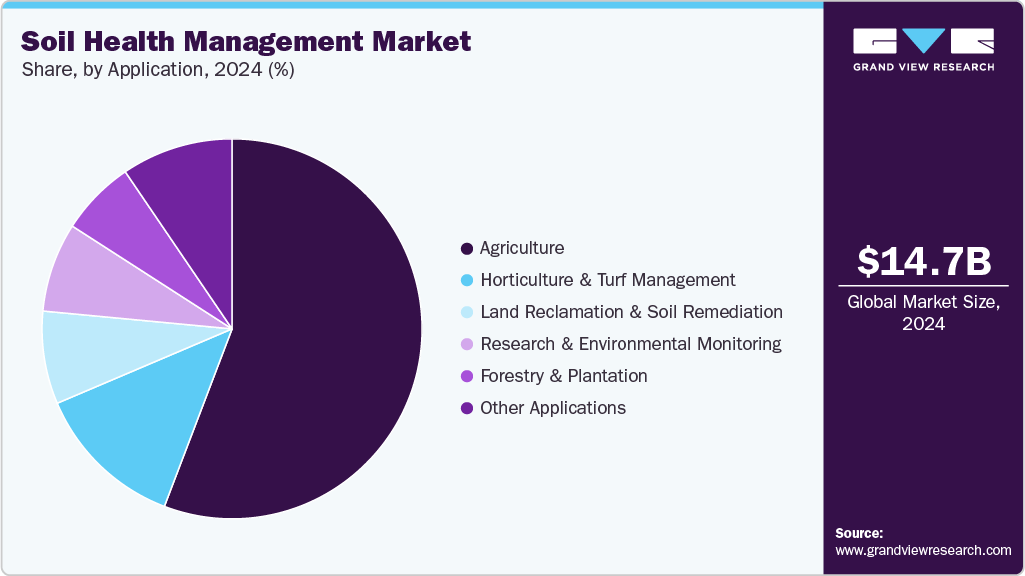
The research & environmental monitoring segment is expected to grow at the fastest CAGR of 13.7% from 2025 to 2033. The focus on studying soil composition, pollution levels, and ecosystem health for sustainable land use and conservation. Research institutions and environmental agencies utilize advanced testing and diagnostic tools to monitor soil quality and assess restoration efforts. Rising global interest in carbon sequestration and soil biodiversity monitoring is expected to strengthen this application area in the coming years.
Regional Insights
The North America soil health management market accounted for the largest revenue share of 34.6% in 2024, driven by advanced agricultural practices, strong government initiatives, and widespread adoption of precision farming technologies. The region benefits from established infrastructure for soil testing, diagnostics, and bio-based inputs. Growing consumer preference for sustainable and organic food production continues to encourage investments in soil restoration and management solutions.
U.S. Soil Health Management Market Trends
The U.S. leads the North America soil health management industry, supported by strong federal programs, such as the USDA’s conservation initiatives, and the widespread adoption of precision agriculture. The presence of major agritech companies and active soil research networks ensures continuous innovation in soil testing, biologicals, and sustainable inputs.
Asia Pacific Soil Health Management Market Trends
The Asia Pacific soil health management industry is expected to grow at the fastest CAGR of 12.5% during the forecast period. This growth is fueled by rising agricultural output, challenges related to soil degradation, and supportive government programs. Nations such as China, India, and Australia are implementing large-scale soil rejuvenation initiatives and promoting the use of organic amendments. Rapid adoption of digital soil monitoring tools and biofertilizers is further strengthening market growth across the region.
China soil health management market is expected to grow during the forecast period. China plays a central role in the Asia Pacific market, with its growth driven by large-scale agricultural production and government-backed soil fertility improvement programs. National initiatives focused on restoring organic matter and reducing synthetic fertilizer use are driving strong demand for biofertilizers and organic amendments.
Europe Soil Health Management Market Trends
Europe’s growth is supported by stringent environmental regulations and policy frameworks that promote sustainable land use. The European Union’s Green Deal and Common Agricultural Policy (CAP) emphasize the conservation of soil fertility and reduced chemical dependency. Countries such as Germany, France, and the Netherlands are leading adopters of biological soil enhancers and monitoring technologies, driving steady regional growth.
The Germany soil health management market is at the forefront of Europe’s soil health management efforts, emphasizing sustainable farming and technological innovation. The country’s advanced research ecosystem and strict environmental regulations promote the adoption of soil testing, microbial products, and organic soil conditioners. Germany’s focus on carbon sequestration and regenerative agriculture continues to shape market growth.
Latin America Soil Health Management Market Trends
Latin America is an emerging market with moderate growth, driven by expanding agricultural production and increasing awareness of soil fertility management. Brazil and Argentina are key contributors, with initiatives promoting soil conservation and reduced reliance on chemical inputs. The growing adoption of sustainable farming and crop rotation practices is expected to gradually boost demand for biological and organic soil health products.
Middle East and Africa Soil Health Management Market
The Middle East & Africa showcase steady demand, with growing interest in soil health management due to challenges such as soil salinity, arid conditions, and desertification. Countries like Saudi Arabia, the UAE, and South Africa are investing in soil remediation, water conservation, and controlled-environment agriculture. Government-led sustainability programs and partnerships with international agritech firms are helping strengthen market development in this region.
Key Soil Health Management Company Insights
Some of the key players operating in the market include TCI Chemicals, UPL Limited, Novozymes A/S, and Atkin Chemicals.
-
BASF SE is a chemical manufacturing company with a presence across Asia Pacific, North America, Central & South America, Europe, and the Middle East & Africa. The company operates through six business segments, namely chemical, material, horticulture & turf management solutions, surface technologies, agricultural solutions, and nutrition & care. The chemical segment encompasses petrochemicals and their intermediates. The material segment comprises performance polymers and monomers. The Horticulture & Turf Management solutions segment includes performance chemicals and dispersions & pigments. The agricultural solution segment includes products for farming, landscape management, and pest control. The nutrition & care segment is further sub-segmented into nutrition & health and care. The company provides a wide range of surfactants for textile, paint & coatings, homecare, and food processing industries.
Key Soil Health Management Companies:
The following are the leading companies in the soil health management market. These companies collectively hold the largest market share and dictate industry trends.
- BASF SE
- Syngenta AG
- Novozymes A/S
- UPL Limited
- Bayer AG
- Corteva Agriscience
- Valagro S.p.A.
- Compass Minerals International, Inc.
- Yara International ASA
- FMC Corporation
- Nutrien Ltd.
- Valagro S.p.A.
- Isagro S.p.A.
Soil Health Management Market Report Scope
Report Attribute
Details
Market size value in 2025
USD 15.84 billion
Revenue forecast in 2033
USD 31.95 billion
Growth rate
CAGR of 9.2% from 2025 to 2033
Base year for estimation
2024
Historical data
2018 - 2023
Forecast period
2025 - 2033
Quantitative units
Volume in kilotons, revenue in USD million, and CAGR from 2025 to 2033
Report coverage
Revenue forecast, volume forecast, competitive landscape, growth factors, and trends
Segments covered
Product, application, region
Regional scope
North America; Europe; Asia Pacific: Latin America; Middle East & Africa
Country scope
U.S.; Canada; Mexico; Germany; UK; France; Italy; Spain; China; India; Japan; South Korea; Brazil; Argentina; Saudi Arabia; South Africa
Key companies profiled
BASF SE; Syngenta AG; Novozymes A/S; UPL Limited; Bayer AG; Corteva Agriscience; Valagro S.p.A.; Compass Minerals International, Inc.; Yara International ASA; FMC Corporation; Nutrien Ltd.; Valagro S.p.A.; Isagro S.p.A.
Customization scope
Free report customization (equivalent up to 8 analyst’s working days) with purchase. Addition or alteration to country, regional, and segment scope.
Pricing and purchase options
Avail customized purchase options to meet your exact research needs. Explore purchase options
Global Soil Health Management Market Report Segmentation
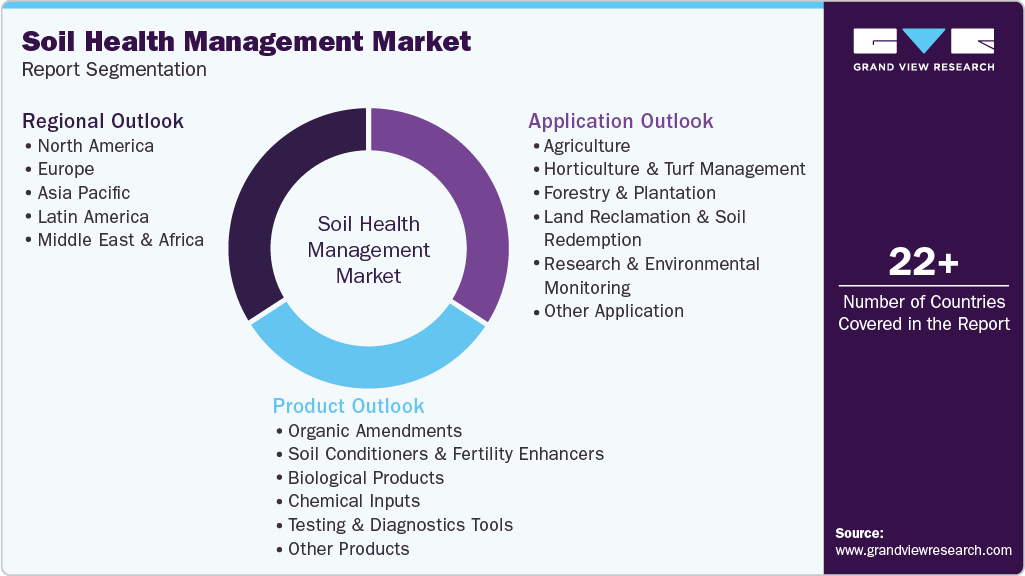
This report forecasts volume & revenue growth at the global level and provides an analysis of the latest industry trends in each of the sub-segments from 2018 to 2033. For this study, Grand View Research has segmented the global soil health management market report based on product, application, and region:
-
Product Outlook (Volume, Kilotons; Revenue, USD Million, 2018 - 2033)
-
Organic Amendments
-
Soil Conditioners & Fertility Enhancers
-
Biological Products
-
Chemical Inputs
-
Testing & Diagnostics Tools
-
Other Products
-
-
Application Outlook (Volume, Kilotons; Revenue, USD Million, 2018 - 2033)
-
Agriculture
-
Horticulture & Turf Management
-
Forestry & Plantation
-
Land Reclamation & Soil Redemption
-
Research & Environmental Monitoring
-
Other Application
-
-
Regional Outlook (Volume, Kilotons; Revenue, USD Million, 2018 - 2033)
-
North America
-
U.S.
-
Canada
-
Mexico
-
-
Europe
-
Germany
-
UK
-
France
-
Italy
-
Spain
-
-
Asia Pacific
-
China
-
India
-
Japan
-
South Korea
-
-
Latin America
-
Brazil
-
Argentina
-
-
Middle East & Africa
-
Saudi Arabia
-
South Africa
-
-
Frequently Asked Questions About This Report
b. The global soil health management market is expected to grow at a compound annual growth rate of 9.2% from 2025 to 2033 to reach USD 31.95 billion by 2033.
b. The North America soil health management market accounted for the largest revenue share of 34.6% in 2024. The driven by advanced agricultural practices, strong government initiatives, and widespread adoption of precision farming technologies. The region benefits from established infrastructure for soil testing, diagnostics, and bio-based inputs.
b. Some key players in the soil health management market are as follow: BASF SE; Syngenta AG; Novozymes A/S; UPL Limited; Bayer AG; Corteva Agriscience; Valagro S.p.A.; Compass Minerals International, Inc.; Yara International ASA; FMC Corporation; Nutrien Ltd.; Valagro S.p.A.; Isagro S.p.A.
b. The market is driven due to the global shift toward sustainable and regenerative agriculture. Increasing concerns over soil degradation, nutrient depletion, and declining fertility levels have prompted governments and farmers to adopt practices that improve long-term soil productivity. Techniques such as crop rotation, organic amendments, and reduced chemical dependency are gaining prominence, supported by policy incentives and international sustainability programs.
b. The global soil health management market size was estimated at USD 14.70 billion in 2024 and is expected to reach USD 15.84 billion in 2025.


Share this report with your colleague or friend.
Need a Tailored Report?
Customize this report to your needs — add regions, segments, or data points, with 20% free customization.


ISO 9001:2015 & 27001:2022 Certified
We are GDPR and CCPA compliant! Your transaction & personal information is safe and secure. For more details, please read our privacy policy.
Trusted market insights - try a free sample
See how our reports are structured and why industry leaders rely on Grand View Research. Get a free sample or ask us to tailor this report to your needs.