Testicular Cancer Drugs Market Summary
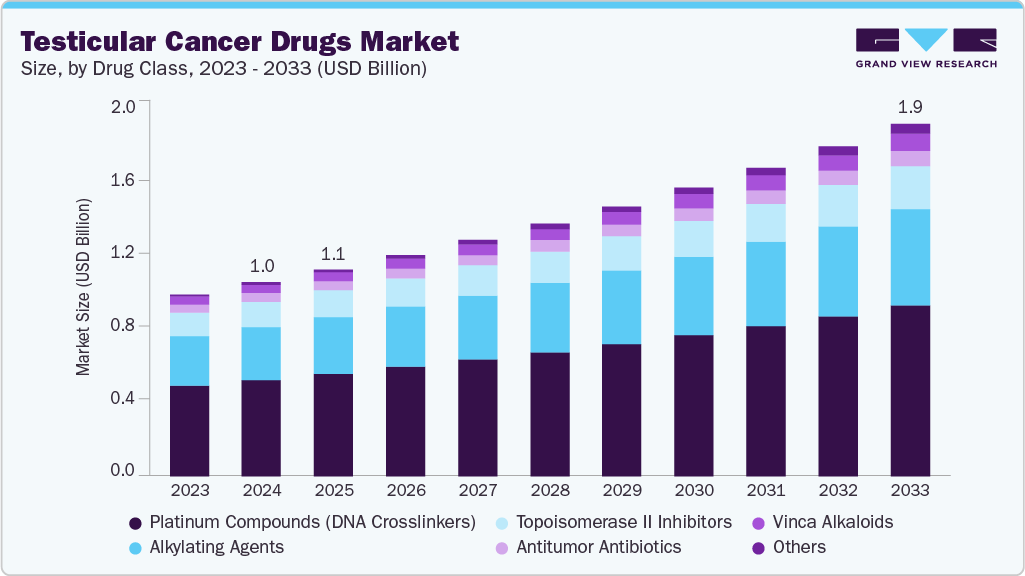
The global testicular cancer drugs market size was estimated at USD 1.08 billion in 2024 and is projected to reach USD 1.97 billion by 2033, growing at a CAGR of 6.9% from 2025 to 2033. The market is primarily driven by improved healthcare infrastructure and access, especially in emerging markets.
Key Market Trends & Insights
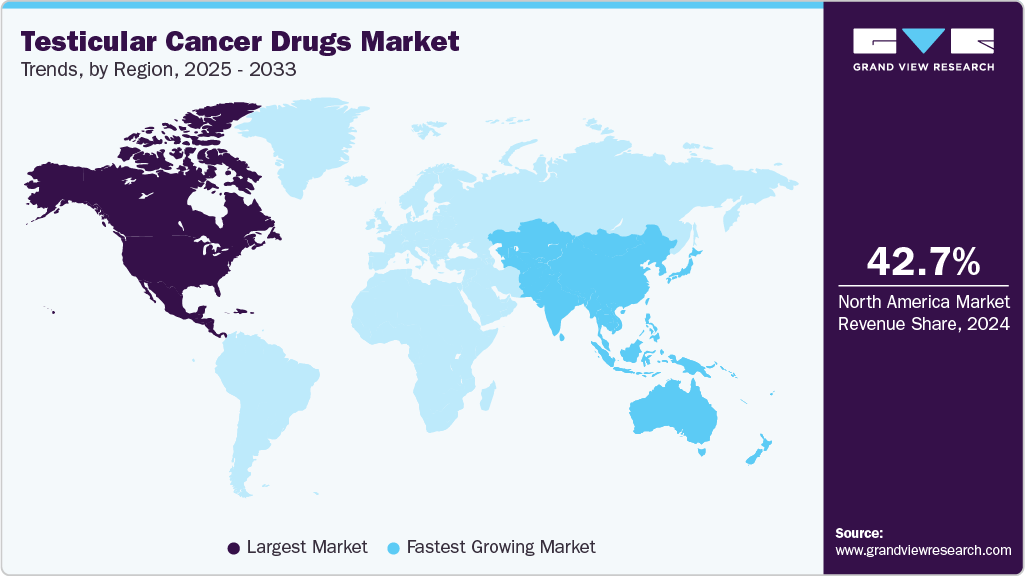
- North America testicular cancer drugs market held the largest share of 42.7% of the global market in 2024.
- The testicular cancer drugs market in the Asia Pacific is expected to register the highest CAGR from 2025 to 2033.
- By drug class, the platinum compounds (DNA crosslinkers) segment held the highest market share of 49.8% in 2024.
- By disease type, the seminoma segment held the highest market share in 2024.
- By distribution channel, the hospital pharmacies segment held the highest market share in 2024.
Market Size & Forecast
- 2024 Market Size: USD 1.08 Billion
- 2033 Projected Market Size: USD 1.97 Billion
- CAGR (2025-2033): 6.9%
- North America: Largest market in 2024
- Asia Pacific: Fastest growing market
Growing awareness, early diagnosis, and advancements in targeted therapies and immunotherapies are boosting treatment adoption. As per the Cancer Council, approximately 1,026 individuals were diagnosed with testicular cancer in 2024, making it the most common cancer in men aged 20-39, excluding non-melanoma skin cancer. The average age at diagnosis is around 36 years. Advancements in treatment modalities, including chemotherapy, radiation therapy, and emerging targeted therapies, have significantly improved patient outcomes, contributing to the market's expansion. In addition, increased awareness and early detection through enhanced diagnostic techniques have led to better prognosis rates, further driving the demand for testicular cancer drugs.
Testicular cancer is the most common solid malignancy affecting individuals with testicles aged 15-44 years, though it accounts for only 1-2% of all tumors in males across all age groups. The vast majority of these cancers, approximately 95%, are testicular germ cell tumors (TGCTs), which form the primary focus of both clinical research and treatment efforts. TGCTs are of particular concern because they typically affect younger men during a highly productive stage of life, creating significant physical, emotional, and social impacts. Advances in surgical techniques, chemotherapy, radiation therapy, and, more recently, targeted and immunotherapies have markedly improved survival rates. Yet, challenges remain in optimizing treatment to minimize long-term side effects such as fertility issues and cardiovascular complications. Early detection is critical, allowing for less aggressive treatment approaches and improving overall prognosis. In addition, research into molecular and genetic markers is helping to refine risk stratification and tailor therapies to individual patients, supporting the broader shift toward personalized medicine in testicular cancer care. Overall, the predominance of TGCTs among young men underscores the importance of continued innovation in diagnosis, treatment, and survivorship support to address both clinical outcomes and quality-of-life considerations.
Market Concentration & Characteristics
The testicular cancer drugs market is characterized by a moderate to high degree of innovation, fueled by ongoing advancements in targeted therapies, immunotherapies, and precision medicine. Companies increasingly focus on next-generation platinum and non-platinum compounds that enhance efficacy while minimizing toxicity.
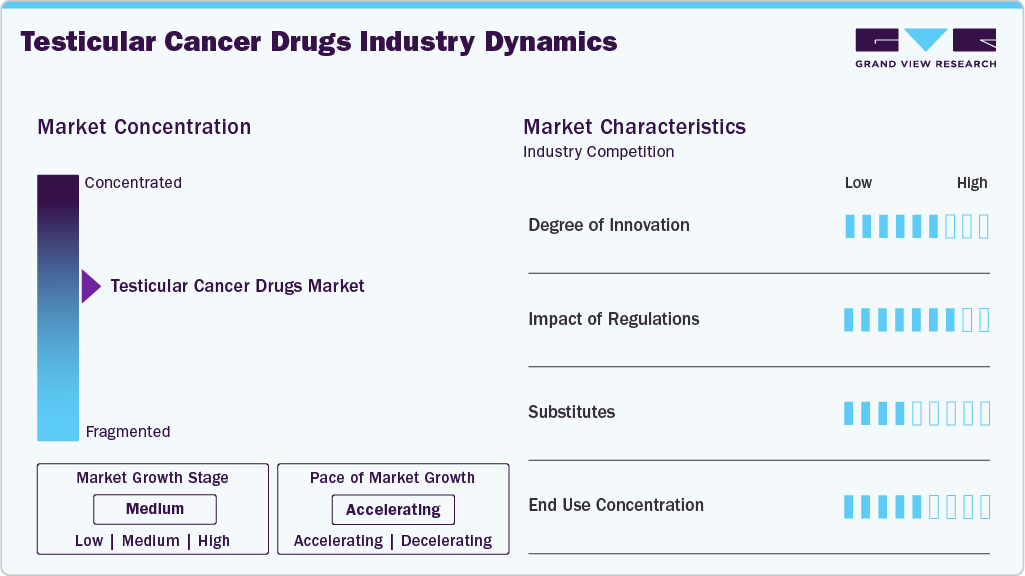
Regulatory agencies such as the U.S. Food and Drug Administration (FDA) and the European Medicines Agency (EMA) emphasize safety, efficacy, and faster approval pathways for oncology drugs, including those targeting testicular cancer.
The market faces minimal competition from product substitutes due to the specialized nature of these therapies. Standard treatment regimens involving chemotherapy, radiotherapy, and surgery remain essential, with limited alternative modalities offering comparable efficacy.
Drug Class Insights
The platinum compounds (DNA crosslinkers) segment dominated the market with the largest revenue share of 49.8% in 2024. Platinum compounds, primarily cisplatin, carboplatin, and oxaliplatin, remain the cornerstone DNA crosslinking agents in testicular cancer therapy. These drugs form covalent bonds with DNA, creating intra- and interstrand cross-links that inhibit replication and transcription, ultimately triggering apoptosis in rapidly dividing tumor cells. The efficacy of cisplatin-based regimens continues to define standard care; however, long-term toxicities remain a concern. A 2024 JAMA Oncology study titled “Comprehensive Audiologic Analyses After Cisplatin-Based Chemotherapy” reported that 78% of testicular cancer survivors treated with cisplatin experienced measurable hearing loss, particularly at cumulative doses above 300 mg/m², with severity linked to age and hypercholesterolemia.
The vinca alkaloids segment is projected to grow at a significant CAGR of 8.1% over the forecast period. Vinca alkaloids are often incorporated into combination chemotherapy regimens, such as BEP (bleomycin, etoposide, and cisplatin), enhancing overall treatment efficacy and survival outcomes. Their established clinical efficacy, coupled with ongoing research to optimize dosing and reduce toxicity, underscores their sustained relevance in managing testicular germ cell tumors across global markets.
Disease Type Insights
The seminoma segment held the largest revenue share of the testicular cancer drugs market in 2024. Genetic, environmental, and lifestyle factors, including family history, cryptorchidism, and exposure to endocrine-disrupting chemicals, influence the incidence of testicular germ cell tumors (TGCTs). Improved awareness, early detection programs, and advanced diagnostic techniques have also contributed to identifying cases at earlier stages, enhancing treatment success. In the U.S., seminoma most commonly occurs in men aged 35-39, with a peak incidence of over 8 cases per 100,000 person-years, while non-seminomatous germ cell tumors (NSGCTs) are more frequent in men aged 25-29, at over 7 cases per 100,000 person-years.
The refractory / relapsed segment is projected to grow at the fastest CAGR over the forecast period. The refractory or relapsed segment represents patients whose disease persists or returns after first-line cisplatin-based therapy, posing significant clinical challenges. Market growth is driven by the increasing number of patients with cisplatin-resistant or high-risk germ cell tumors, advances in multidisciplinary treatment protocols, and rising demand for therapies that improve progression-free and overall survival in this difficult-to-treat population.
Distribution Channel Insights
The hospital pharmacies segment held the largest share in the testicular cancer drugs industry in 2024. Hospital pharmacies serve as a critical distribution channel for drugs, particularly chemotherapy agents such as platinum compounds, alkylating agents, and other supportive therapies.
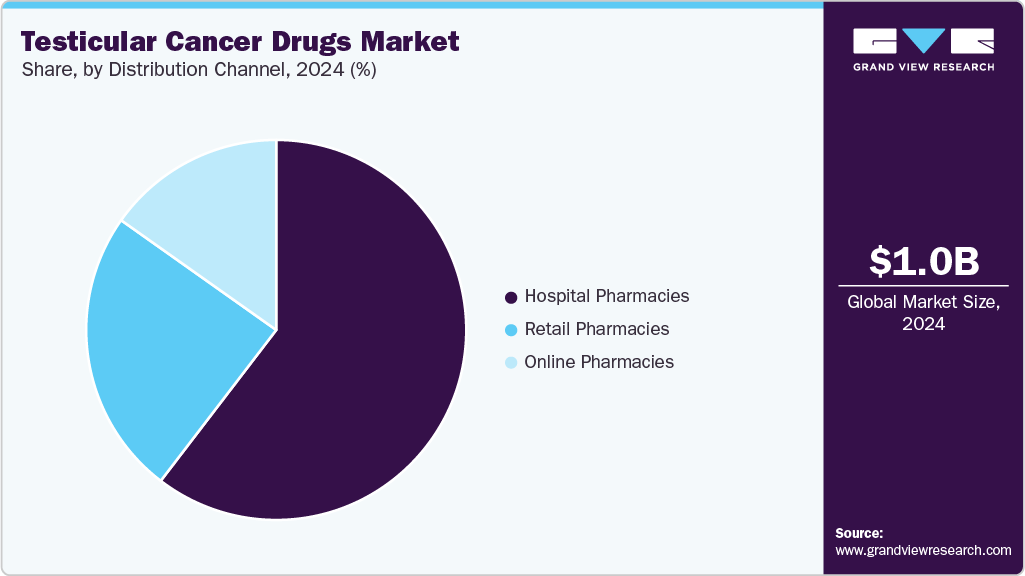
These pharmacies ensure that high-cost, specialized medications are safely stored, accurately dosed, and administered under medical supervision. This is essential given the toxicity profiles and complex regimens involved in testicular cancer treatment.
The online pharmacies segment is anticipated to grow fastest over the forecast period. Online pharmacies are emerging as a growing source for testicular cancer drugs, offering convenient access to therapies.
Regional Insights
North America testicular cancer drugs market dominated the global industry and accounted for 42.7% of the market in 2024, attributed to its robust healthcare infrastructure, high awareness levels, and significant investment in oncology research. The region's well-established regulatory frameworks, favorable reimbursement policies, and access to cutting-edge diagnostic technologies further enhance the adoption of novel therapies. In addition, the presence of leading pharmaceutical companies and active participation in global clinical trials contribute to continuous innovation and improved patient outcomes in the disease treatment.
U.S. Testicular Cancer Drugs Market Trends
The testicular cancer drugs market in the U.S. accounted for the largest share in North America in 2024. The incidence rate of testicular cancer has been increasing over the past few decades, particularly in seminomas. Interestingly, the rise in incidence rates is now observed across various racial and ethnic groups, including Hispanic men, whose incidence rates have increased to match those of non-Hispanic White men for the first time.
Europe Testicular Cancer Drugs Market Trends
Europe testicular cancer drugs market represented a significant share in 2024. This rising prevalence highlights a sustained need for effective systemic and supportive therapies, particularly as many patients require long-term follow-up or relapse management. The combination of increasing survivor numbers, high survival rates, and disparities in access to advanced treatment options across European countries is driving the demand for modern testicular cancer drugs, including targeted and immuno-oncology therapies.
The testicular cancer drugs market in UK is growing at a stagnant rate as the prevalence is expected to decrease over the forecast period. However, the launch of new drugs or therapies could lead the market to expand dramatically.
The testicular cancer drugs market in Germany is driven by the strong infrastructure and early adoption of target therapies. However, the gold standard treatment for testicular cancer in Germany is platinum-based chemotherapy, and hence the shift to novel therapies is slower.
Asia Pacific Testicular Cancer Drugs Market Trends
Asia Pacific testicular cancer drugs market is projected to grow at the fastest CAGR of 8.1% over the forecast period. In the AsiaPacific region, the demand for testicular cancer drugs is driven by rising awareness, improving diagnosis rates, and expanding access to specialized oncology care. Increasing survival rates and long-term patient management encourage the adoption of advanced therapies, including targeted and immuno-oncology treatments.
The testicular cancer drugs market in India is driven by increasing awareness, improving diagnostic capabilities, and expanding access to specialized oncology care. Growing survival rates and long-term patient management needs are encouraging the adoption of advanced therapies, including targeted and immuno-oncology treatments.
The testicular cancer drugs market in India is primarily growing due to the rising disease burden. The Chinese Center for Disease Control and Prevention (China CDC) reported in 2024 that testicular cancer incidence was 7.5, the total population was 26,843, and mortality rates continue to rise, with a notable increase in the number of cancer survivors due to advancements in early detection and treatment. This growing survivor population necessitates ongoing management and access to effective therapies. The factors underscore the importance of expanding access to specialized oncology care and modern drug regimens to meet the evolving healthcare needs of the population.
Latin America Testicular Cancer Drugs Market Trends
Latin America testicular cancer drugs market is expected to grow steadily over the forecast period, owing to improved diagnostics & early detection of testicular cancer. Brazil is the largest market in Latin America as the private insurance coverage is expanding and there is a rise in centralized oncology centers in the country. Chemotherapy treatment remains the standard or backbone, however, the use of targeted & immune-agents are emerging in the region.
MEA Testicular Cancer Drugs Market Trends
MEA testicular cancer drugs market is witnessing steady growth due to improved diagnostics and oncology capacity in richer GCC markets and by improving access in several African countries. Platinum-based chemotherapy regimens remain the standard first-line therapy across MEA, forming the bulk of drug volumes and hospital pharmacy spend. Private hospital networks and specialty cancer centres (especially in GCC, Egypt, South Africa) drive early adoption of higher-cost agents.
Key Testicular Cancer Drugs Company Insights
Key players operating in the testicular cancer drugs market are undertaking several strategic initiatives, such as mergers and acquisitions, and partnerships with other major companies. Companies are mainly focusing on manufacturing novel drugs to garner a higher market share.
Key Testicular Cancer Drugs Companies:
The following are the leading companies in the testicular cancer drugs market. These companies collectively hold the largest market share and dictate industry trends.
- Bristol-Myers Squibb Company
- Pfizer Inc.
- Baxter.
- Recordati Industria Chimica e Farmaceutica S.p.A
- Teva Pharmaceutical Industries Ltd.
- Fresenius SE & Co. KGaA
- Sagent
- Viatris Inc.
- Sun Pharmaceutical Industries Ltd.
- Hikma Pharmaceuticals PLC
- Sandoz Group AG
Recent Developments
-
In October 2025, Natera, Inc. announced the publication of the largest-ever testicular cancer ctDNA study, published in JCO Precision Oncology. The study showed that its Signatera test significantly outperformed standard serum tumor markers.
Testicular Cancer Drugs Market Report Scope
|
Report Attribute
|
Details
|
|
Market size value in 2025
|
USD 1.16 billion
|
|
Revenue forecast in 2033
|
USD 1.97 billion
|
|
Growth rate
|
CAGR of 6.9% from 2025 to 2033
|
|
Base year for estimation
|
2024
|
|
Historical data
|
2021 - 2023
|
|
Forecast period
|
2025 - 2033
|
|
Quantitative units
|
Revenue in USD million/billion and CAGR from 2025 to 2033
|
|
Report coverage
|
Revenue forecast, company ranking, competitive landscape, growth factors, trends
|
|
Segments covered
|
Drug class, disease type, distribution channel, region
|
|
Regional scope
|
North America; Europe; Asia Pacific; Latin America; Middle East & Africa
|
|
Country scope
|
U.S.; Canada; UK; Germany; Italy; France; Spain; Sweden; Denmark; Norway; Japan; China; India; Australia; South Korea; Thailand; Brazil; Mexico; Argentina; South Africa; Saudi Arabia; UAE; Kuwait
|
|
Key company profiled
|
Bristol-Myers Squibb Company; Pfizer Inc.; Baxter.; Recordati Industria Chimica e Farmaceutica S.p.A; Teva Pharmaceutical Industries Ltd.; Fresenius SE & Co. KGaA; Sagent; Viatris Inc.; Sun Pharmaceutical Industries Ltd.; Hikma Pharmaceuticals PLC; Sandoz Group AG
|
|
Customization scope
|
Free report customization (equivalent up to 8 analysts working days) with purchase. Addition or alteration to country, regional & segment scope.
|
|
Pricing and purchase options
|
Avail customized purchase options to meet your exact research needs. Explore purchase options
|
Global Testicular Cancer Drugs Market Report Segmentation
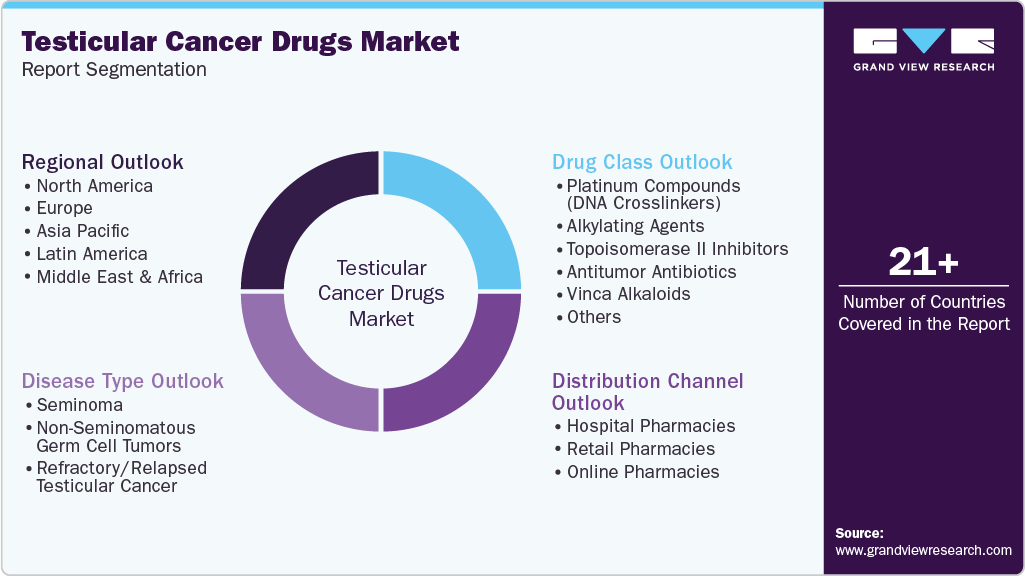
This report forecasts revenue growth at global, regional, and country levels and provides an analysis of the latest industry trends in each of the sub-segments from 2021 to 2033. For this study, Grand View Research has segmented the global testicular cancer drugs market report based on drug class, disease type, distribution channel, and region:
-
Drug Class Outlook (Revenue, USD Million, 2021 - 2033)
-
Disease Type Outlook (Revenue, USD Million, 2021 - 2033)
-
Distribution Channel Outlook (Revenue, USD Million, 2021 - 2033)
-
Hospital Pharmacies
-
Retail Pharmacies
-
Online Pharmacies
-
Regional Outlook (Revenue, USD Million, 2021 - 2033)
-
North America
-
Europe
-
Germany
-
UK
-
France
-
Italy
-
Spain
-
Sweden
-
Denmark
-
Norway
-
Asia Pacific
-
China
-
India
-
Japan
-
Australia
-
South Korea
-
Thailand
-
Latin America
-
Middle East & Africa
-
South Africa
-
Saudi Arabia
-
UAE
-
Kuwait

 Download Sample Report